
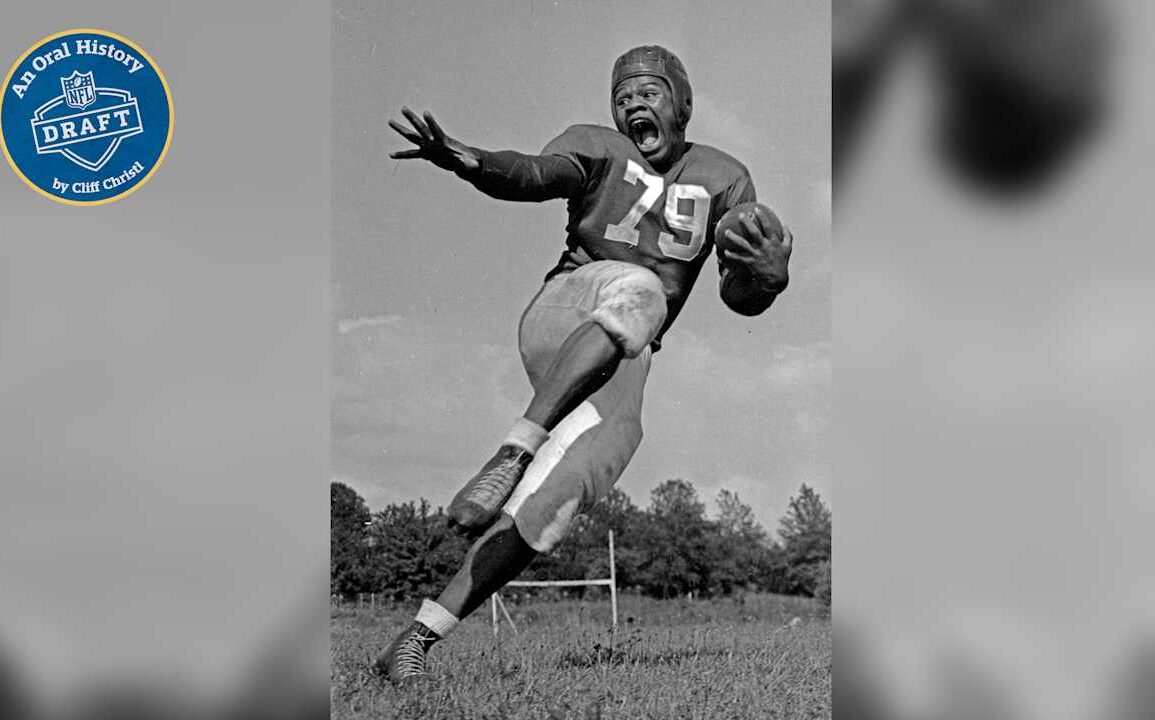
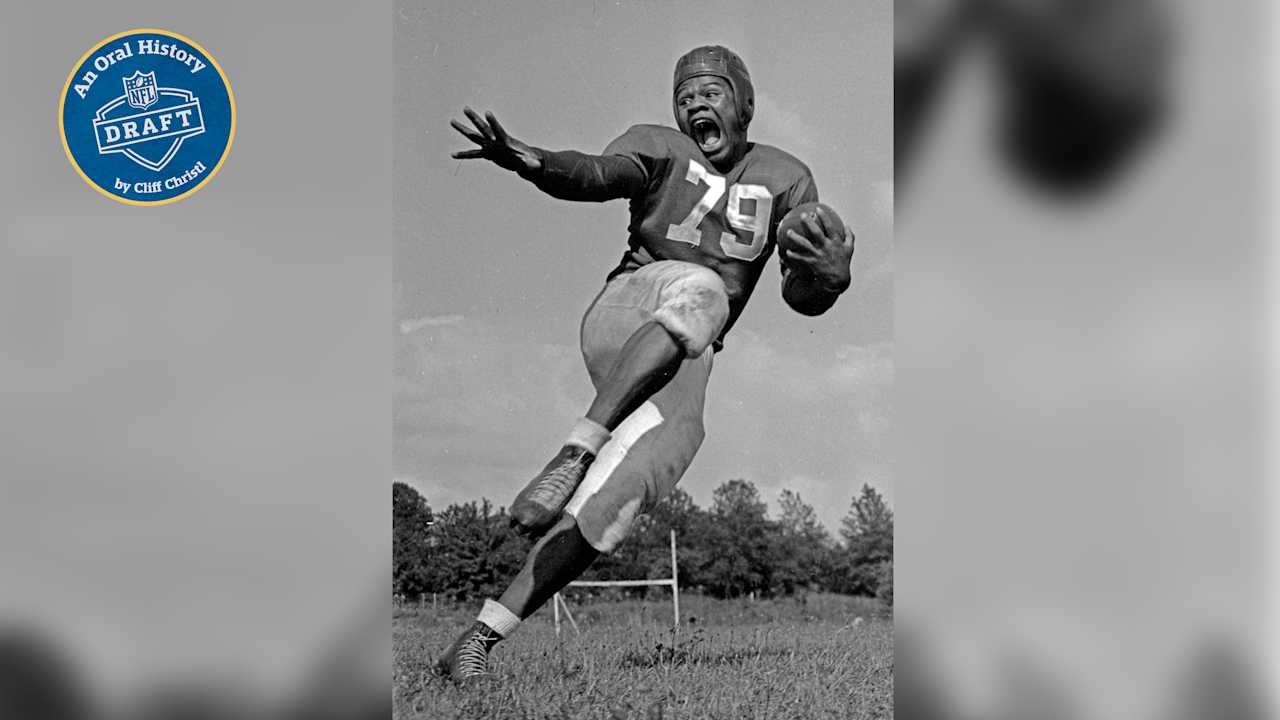
George Taliaferro: First Black player selected in an NFL Draft
It would be another three years before Eddie Macon became the first Black player to perform for the Chicago Bears, but owner-coach George Halas at least broke new ground when he chose Indiana’s triple-threat left halfback George Taliaferro in the 13th round of the 1949 draft.
Taliaferro (6-0, 190) was the first Black player ever chosen in an NFL Draft.
In 1946, the Cleveland Rams had signed halfback Kenny Washington and end Woody Strode, breaking a color barrier that had been in place in the NFL since 1933. In the AAFC, the Cleveland Browns also signed two Black players that year, Bill Willis and Marion Motley.
Both Washington and Strode had gone undrafted in 1940 following their senior seasons at UCLA. In Washington’s case, he led the Bruins in rushing and passing for three straight years as a triple-threat halfback and might have been worthy of being the No. 1 overall pick that year if there hadn’t been a ban against Black players.
When Washington was bypassed, it sparked considerable public criticism of the NFL’s policy for the first time, at least as it related to the draft.
A year later, Jackie Robinson led UCLA in rushing and passing, while also leading the country in punt returns with a 21-yard average on 19 returns. Again, if Blacks had been allowed to play in the NFL at the time Robinson might have been that year’s No. 1 pick. It’s even conceivable that he might have broken the color barrier in pro football before doing so in Major League Baseball.
In January 1947, Buddy Young, a product of Chicago’s Wendell Phillips High School, dropped out of the University Illinois following that year’s draft, which had been held in late December 1946. However, he likely would have been eligible for an exemption to play in the NFL that year and a valuable gate attraction for the Bears.
A 5-foot-4, 175-pound halfback, Young placed fifth in Heisman Trophy voting in 1944 as a freshman at Illinois. His rushing average that season was 8.9 yards per carry. In track, Young won the NCAA 100-yard dash in 9.7 seconds.
Drafted into the Army in 1945, Young led Fleet City to a 48-25 victory over the El Toro Marines in what was billed as the national service football championship. He stole the show by returning a kickoff 94 yards for a touchdown, a punt 88 yards for a touchdown and running 20 yards from scrimmage for a touchdown.
Young returned to Illinois and played there in 1946. After he dropped out of school, he signed with the New York Yankees and finished fifth in the AAFC in rushing, averaging 6.1 yards per carry, as a rookie. Apparently, the Bears were never in the picture.
Finally, two years later, Halas appeared ready to welcome his first Black player, only to have Taliaferro rebuff him.
In 1945, as a 17-year-old freshman, Taliaferro led Indiana University to a 9-0-1 record, to this day its only undefeated season in 125 years of football, and the championship of the Big Ten, one of only two conference titles the Hoosiers have won since 1900.
As a triple-threat left halfback in what coach Bo McMillan called his “cockeyed T” formation, Taliaferro finished seventh in the country in rushing with 728 yards and a 4.7 average per carry.
After starring for the Virginia-based Fort Lee Travelers the following fall, he returned to Indiana in 1947 and played two more seasons. Although he dealt with multiple injuries both years, he was named Associated Press All-Big Ten in 1947.
Despite growing up a Bears fan in Gary, Ind., Taliaferro signed with the Los Angeles Dons of the AAFC two weeks after the two league drafts. As a rookie, playing tailback in the Dons’ single-wing offense, Taliaferro finished seventh in the AAFC in total yards.
Following what was the AAFC’s final season, Taliaferro was drafted second by the New York Yanks in the NFL’s 1950 allocation draft. Taliaferro then played six more years with the Yanks, Dallas Texans, Baltimore Colts and Philadelphia and was a three-time Pro Bowl pick.
McMillin, coach at Indiana from 1934-47, former Walter Camp All-American quarterback at Centre College and future coach of the Detroit Lions (Indianapolis News, Oct. 3, 1946): “Taliaferro is perhaps the best ball carrier I’ve seen in the Big Ten since I came to Indiana.”
Dom Tomasi, captain of Michigan’s 1948 AP mythical national champions, on Taliaferro (United Press, Dec. 3, 1948): “Greatest back I ever saw. Glenn Davis and Doc Blanchard of Army are the next best backs.”
Columnist Al Vaughn of the short-lived Illinois Standard, a newspaper that tried to appeal to readers of all colors, all minority groups and all religions (Jan. 1, 1949): “George Halas fooled the sports world by drafting George Taliaferro. Nobody actually knows whether Halas intends to sign Taliaferro or to use him just for trading purposes. One thing is for sure if the great Indiana star ever gets behind the Bear line, he will do things never before seen in pro football. For our money, Taliaferro is the best back going in the business today and would make the Bears nigh on to unbeatable.”
Vaughn (Illinois Standard, Jan. 15, 1949): “Those who were wondering whether or not George Halas would actually sign George Taliaferro need not wonder anymore. George has been signed by the Los Angeles Dons. We suspect Taliaferro didn’t quite trust Mr. Halas, and you can’t blame the guy when you consider that the owner of the Bears got around to drafting Taliaferro, the best halfback in the country, as his 17th choice.”
With Taliaferro playing in the AAFC as a rookie, Wally Triplett earned the distinction of being the first draftee to play in the NFL. A halfback from Penn State, Triplett was selected by Detroit in the 19th round in 1949.