
Tales of cloak-and-dagger tactics
In the sixth year of competition for college football’s best pro prospects and with a king’s ransom of new television money to pay those blue-chippers, the NFL and AFL put as much emphasis on skullduggery as they did scouting in making their selections.
In fact, Norm Miller of the New York Daily News reported the day before the scheduled drafts that the AFL had conducted a secret one by phone two weeks earlier, despite both leagues promising the NCAA that they would wait until the final Saturday of the college season to make their picks and sign players.
AFL officials denied the story, but Miller correctly reported five of the AFL’s eight first-round choices, including the trade that allowed the New York Jets to draft quarterback Joe Namath.
Two days after Miller broke his story, the Daily News’ Dick Young uncovered another scoop. Young obtained a letter written by Carl Lindermann Jr., then vice president of sports at NBC, and mailed to an untold number of that year’s draft prospects encouraging them to sign with an AFL team.
Lindermann told the collegians that NBC had invested $36 million in a five-year TV contract with the upstart league and concluded his letter with the following request: “We hope you will join us in this endeavor.”
Detroit Free Press columnist Lyall Smith reported that NBC also had advanced a total of $1.25 million to certain AFL teams to be used immediately in the bidding war for players.
NFL counters with “Babysitters”
In the fall of 1964, only a month or so before the draft, NFL Commissioner Pete Rozelle, at the suggestion of Los Angeles Rams owner Dan Reeves, conceived a plan to recruit businessmen and others living near major university cities who would then attempt to befriend prospective draft picks and start selling them on the advantage of playing in the NFL over the AFL.
Rozelle, in turn, put Bert Rose, who had recently been rehired by the Rams after spending three years as Minnesota’s general manager, in charge of what was called the NFL’s “Babysitter” operation. Rose had been public relations director of the Rams in the 1950s when Rozelle was their GM.
Rose (Christl interview, Jan. 18, 1979): “This was late October. That gave us very little time for what we had in mind. First, I had to secure a sales force. So we queried each of the 14 clubs to provide some names of people who were close to their club, who were sales oriented individuals. … Almost without exception our NFL representatives, professionally speaking, were salesmen. From this list, I added about 30 or 40 personal friends of mine from where I had lived: Seattle, Los Angeles, Minneapolis. We finally totaled in the neighborhood of about 90 NFL representatives.”
The next step was to develop an instructional pamphlet, explaining what the league expected them to accomplish. That done, the reps were instructed to report to one of four cities – Chicago, Dallas, New York and San Francisco – on the weekend before the draft.
Rose (Christl interview, Jan. 18, 1979): “We called these clinics. I conducted the clinic in Dallas on Friday and in Chicago on Saturday. Pete conducted the clinic in San Francisco on Saturday. Jim Kensil (Rozelle’s top aide in the NFL office) conducted the clinic in New York. These people ran the gamut of say a territory man for Johnson & Johnson, a vice president of sales for the Sunbeam Corp. I had about eight representatives from Minneapolis who had been part of an organization called ‘The Minutemen,’ who had been helpful to the Vikings selling season tickets. They could either get a per diem (for being babysitters) – as I recall it was like $50, plus all expenses – or a gift when it was all over.”
Meanwhile, the NFL also enlisted a team of supervisors to orchestrate the draft-day signings from the Lexington Hotel in New York. The supervisors were mostly friends of Mara, Rozelle and Rose.
Starting on Monday, five days before the draft, the babysitters began contacting players and arranging visits with them. Babysitters also were given blank NFL contracts and instructed to have their own checkbooks with them so they could finalize signings and immediately pay the bonus money. The NFL’s supervisors, in turn, were prepared to quickly wire the funds to reimburse the babysitters’ accounts.
Rose (Christl interview, Jan. 18, 1979): “(The babysitters) were to sell the guy on going with them somewhere, hopefully Wednesday night, school being out for Thanksgiving. The usual suggestion – a lot of these kids had never seen a pro game – ‘You want to go to San Francisco to see the 49ers play the (Baltimore Colts)?’ We’ll go on Wednesday and have a ball: Thursday, Friday and the draft is on Saturday. These kids thought that was terrific. Players were spread out all over the nation. And most importantly they were away from where our opponents would try to find them. They just vanished into thin air. Gone.”
When the operation worked according to plan, the babysitters were waiting side-by-side with their assigned players in a luxury hotel room somewhere, when an NFL team wanted to make contact.
That way, when a team was ready to make its pick, it could call a supervisor in New York and have the call patched to the babysitter and the player, wherever they were. Better yet, before a team handed in its pick, its GM or coach could talk to the player, agree on contract terms and have a babysitter finalize the signing before the selection was announced.
An example cited by Rose was the signing of Indiana fullback Tom Nowatzke, who was drafted 11th overall by Detroit. In the AFL, the Jets took Nowatzke with their own first-round pick, the fourth overall.
Rose (Christl interview, Jan. 18, 1979): “I assigned a fella named Dick Pollard to Nowatzke on the Saturday before the draft in Chicago. Dick spent Monday through Friday in Bloomington, Ind., including Thanksgiving dinner at Nowatzke’s house. They became bosom buddies. On Friday, Nowatzke was scheduled to depart for New York for the Eastman Kodak All-American football team (event). And the Jets told Nowatzke they wanted to make him their first draft choice. So (Jets owner) Sonny Werblin and (coach) Weeb Ewbank were at LaGuardia Airport to meet him when he got off the plane with Pollard.
Rose: “Introductions were made and they ask, ‘Who is Mr. Pollard?’ ‘Just a friend of mine traveling with me.’ So they get in a limousine and stop off at Shea Stadium. Pollard is tagging right along. … They tried to sign (Nowatzke) before the draft but he said no. Evidently, though, he left them with the impression he was completely open-minded. So they leave and Pollard gets an adjacent room (to Nowatzke) at the Waldorf Astoria and was with him all the time, from then until the draft. The Jets made (Nowatzke) a first-round draft choice and so did the Lions. While the Lions were announcing him as their first choice, he was signing a Detroit contract. And the Jets had drafted a guy they can’t find.”
Otis Taylor: Virtually kidnapped by the AFL
According to Rose, all but five or six of the 90 players who had a babysitter with them signed with the NFL. But not all of the babysitting efforts went off as planned. Flanker Otis Taylor of Prairie View A&M was a prime example of one that didn’t.
In January 1962, the Dallas Texans of the AFL hired Don Klosterman as chief scout. Klosterman had held the same title when he assembled the talent that allowed the Los Angeles Chargers in 1960 and the San Diego Chargers in 1961 to capture the AFL’s first two Western Conference titles. In his first season with the Texans, Klosterman put together the roster that won that year’s AFL championship.
In the process, he gained a reputation for being a friend to the coaches at the Historically Black Colleges, mostly of the South, and mining their talent when other teams, especially, in the NFL had self-imposed quotas on signing Black players.
In 1965, Klosterman – the Texans had become the Kansas City Chiefs in 1963 – targeted Taylor as another potential gem from what are now called HBCU schools. In fact, four of Klosterman’s first nine draft picks that year were from HBCUs and all of them would play for the Chiefs. Plus, Klosterman’s first two choices in the AFL’s separate redshirt draft Grambling defensive tackles, Alphonse Dotson and Frank Cornish.
Thanks to scout Lloyd Wells, the Chiefs were able to snatch Taylor (6-3, 215) from his NFL babysitters, draft him in the fourth round and sign him.
Peppler on whether the Packers would have drafted Taylor No. 1 before taking 75 minutes to settle on redshirt halfback Donny Anderson as their choice (Christl interview, April 4, 2005): “Oh yeah. We were calling (Taylor) up and had made preliminary contact with the babysitters, and they said he had just stepped out for something or whatever. Well, it turned out, (Taylor) had gone out the back window.”
Klosterman (Christl interview, Dec. 12, 1978): “I spent a lot of time with (Taylor). His mother was a great pal of mine. Babysitters, a lot of them from Dallas, put him in a hotel (in Houston) and wouldn’t allow any phone calls. One of my sleuths told me about it, and I called Otis’ mother. I said, ‘Do you know your son has been kidnapped?’ She said, ‘What?’ I said, ‘Yeah, kidnapped.’ He’s in a hotel and I can’t get to him. She said, ‘I’ll call the police department.’
Klosterman: “So (the babysitters) knew we were on their tail and take these guys to a Holiday Inn in Dallas. We had Lloyd Wells go up there. It was just like running the CIA with telephone communication, ‘Where are you?’ ‘I’m outside the hotel in a telephone booth. They have people blocking the lobby.’ I said, ‘It’s a hotel lobby. They can’t block you. Go around the back and knock on the window.’ … (Taylor) was with Seth Cartwright, his teammate. So like 3 in the morning, (Lloyd) got them out of the hotel through a back window. Flew them up to Kansas City. I knew Otis always wanted a red convertible, a red T-bird. So he got here and I said, ‘Otis, come around the back and see what I’ve got for you.’ He said, ‘God, is that mine?’ I said, ‘Yeah, sign right here.’ And we signed him right away.”
Rose (Christl interview, Jan. 18, 1979): “I think (the players) felt they were captives. And I think these two reps got into a party; that’s what I really think happened. Girls and booze and cards and so on.”
Grambling coach Eddie Robinson on Klosterman (Christl interview, March 19, 1979): “He knew where all the Black ballplayers were. When they formed the other league there were more jobs available. That’s when teams really started looking at the Black schools.”
In 1966, Taylor averaged 22.4 yards on his 58 regular-season receptions, and the Packers considered him the Chiefs’ most dangerous offensive weapon heading into Super Bowl I.
Namath lands in New York, becomes “Broadway Joe”
A native of Pennsylvania steel town Beaver Falls and a product of Bear Bryant’s Alabama football program, Joe Willie Namath wasn’t yet “Broadway Joe” when he was drafted. It was Jets veteran tackle Sherman Plunkett who christened him with the name after Namath appeared on the cover of Sports Illustrated before the start of his first pro training camp. Next to Namath’s picture was the headline, “Football Goes Show Biz.”
In the 1965 AFL draft, the Jets had grabbed Namath with the second overall pick after obtaining it in a trade with the Houston Oilers. In the NFL draft, the St. Louis Cardinals took Namath with the 12th overall choice.
Although Namath had torn cartilage in his right knee and missed considerable playing time as a senior, Alabama coach Bear Bryant had declared in mid-November, “This boy not only is the best football player I ever coached, he’s the best I’ve ever seen.”
What Bryant was crowing about was Namath’s whip-like release, shrewd football mind and athletic gifts that enabled him to play safety in a pinch. The only red flag was Namath’s bum right knee, which would require surgery following the season.
LESTO scout Ken Stilley (Fall 1964 Report, Pro Football Hall of Fame): “This boy is a AA rating, a great quarterback prospect. Passes very well. In the Georgia game, he completed 16 out of 20. A great prospect. Very good rollout passer and runner. Will take off with the ball where he is trapped. Has good control of team. Good speed.”
Pat James, Louisiana State offensive line coach and former longtime Bryant assistant (Fall 1964 LESTO Report, Pro Football Hall of Fame): “Great passer. Quick and accurate passer, long and short. Lot of savvy. One of the best quarterback prospects I have seen. Could play inside safety. Has that knack.”
Texas coach Darrell Royal (Miami Herald, Jan. 3, 1965): “(Namath) was simply fantastic (in the Orange Bowl). I don’t believe in comparisons but I’ll say this: He has to be one of the greatest quarterbacks I’ve ever seen.”
Jets coach Weeb Ewbank (Press conference, Jan. 2 1965): “I see in this young man the same qualities as those of Johnny Unitas. He has size, quickness, courage and a wonderful arm.”
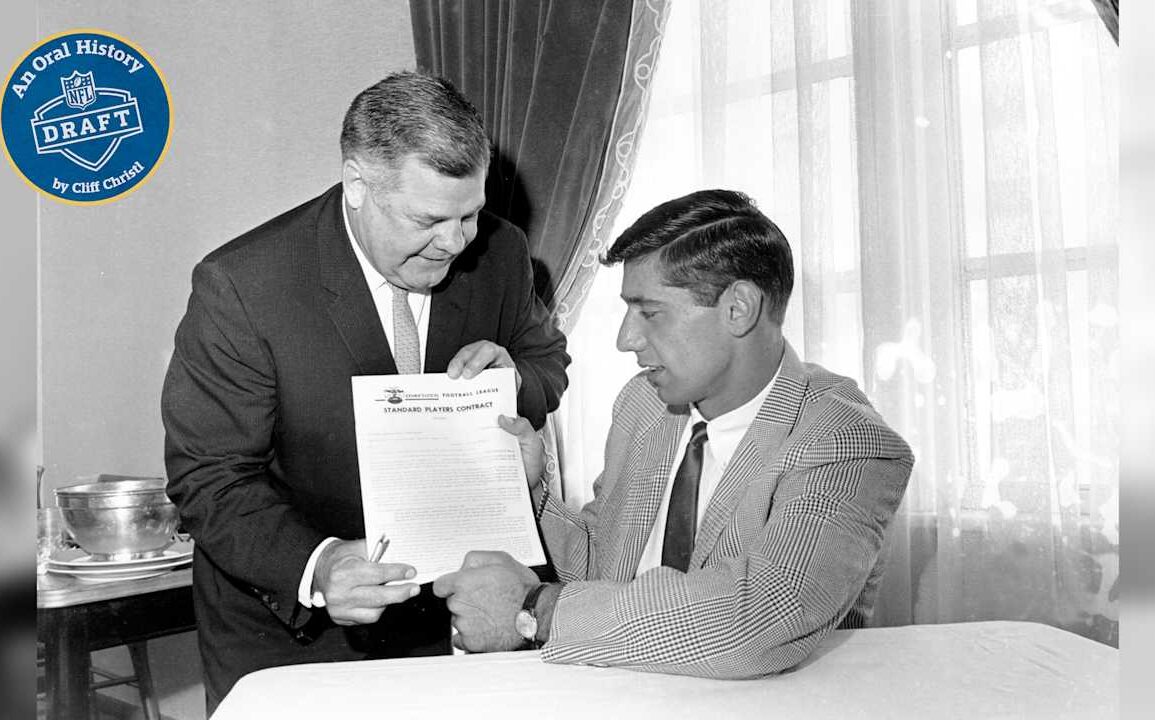
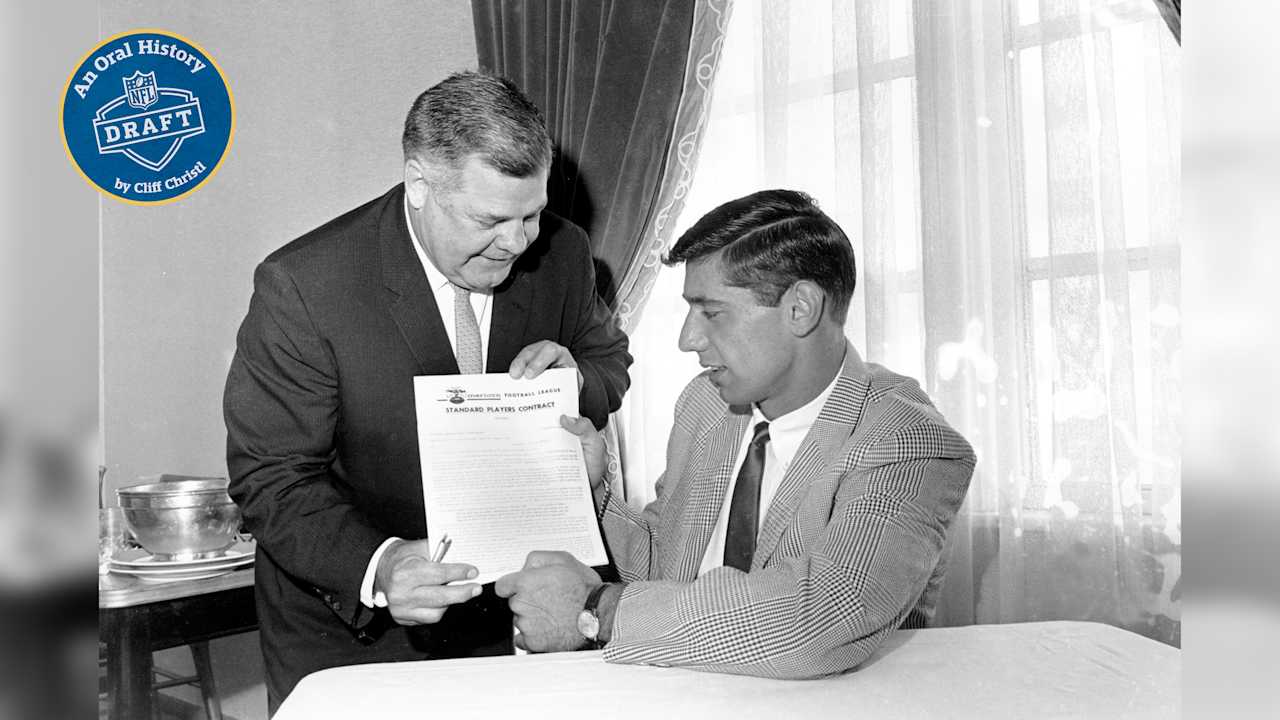
Namath’s signing by Werblin, the Jets’ owner, for a reported $300,000 in salaries over the next three seasons, a $100,000 bonus and other amenities – a package that was believed to be double what any pro football rookie had been paid in the past – was announced in a lavish press conference in Miami, the day after Namath’s sparkling performance against Texas in the Orange Bowl. Three days before the game, the bidding had gotten so rich that the Cardinals bowed out of the negotiations.
The publicity splash resulted in the Jets selling 35,000 season tickets before the 1965 season compared to 11,000 the year before and looking to show a profit after losing a reported $648,000 the previous year.
Namath led the AFL in passing in both his second and third seasons, including a benchmark performance in 1967 when he became the first pro quarterback to throw for more than 4,000 yards in a season. The next year, Namath led the 18-point underdog Jets to victory in Super Bowl III.
But starting with his sixth season, his gimpy knees and other injuries took a toll. From 1970-73, Namath missed 28 games. Nevertheless, pro football’s Renaissance man John Madden once said that Namath had the best-looking drop, release and pass that he had ever seen.
Bears nail daily double: Dick Butkus and Gale Sayers
Owning three picks in the first round, the Chicago Bears hit on what might still rank as the best first-round, one-two combo in draft history when they snared two future Hall of Famers: Illinois linebacker-center Dick Butkus with the third overall pick and Kansas halfback Gale Sayers with the fourth.
The Bears used the sixth choice of the first round on Tennessee lineman Steve DeLong, who enjoyed a solid eight-year career: seven with the Chargers and his final season with the Bears.
Bears then assistant coach George Allen (Christl interview, April 18, 1979): “I put on the board in big letters three guys (Butkus, Sayers, DeLong) that if we get a chance we should draft them. We needed a linebacker, a running back, a defensive end. I can remember seeing the names on the blackboard in the back room in big letters, and they all became available. I ran the draft; (George) Halas made the picks. We didn’t expect them to all be there, but we were hopeful.”
The scouts working for the combine the Bears were about to join were in agreement about their potential.
On Butkus (6-3, 250)
LESTO scout Bill Daddio, (Fall 1964 Report, Pro Football Hall of Fame): “Can play either offensive center or middle linebacker. Did a terrific job of blocking. … As a middle linebacker, he was all over the field making tackles. First one down on punt coverage. He is a good one, center or middle linebacker in pro ball.”
Pittsburgh scout Art Rooney Jr. (Fall 1964 LESTO Report, Pro Football Hall of Fame): “OFFENSE – He has a fine initial pop. Likes to hit and get downfield fast. He drops back good on pass blocking. DEFENSE – The best college linebacker I ever saw. … He has the size and activeness of a good pro now. He is right on every play and has good recovery when blocked. He is mean and alert.”
BLESTO scouting director Jack Butler (Summer 1965 Report at All-American Football Game in Buffalo, Pro Football Hall of Fame): “Very strong linebacker. Has the instincts, tough, mean, always where the ball is. Slow getting back on pass defense. Can’t change directions easily.”
On Sayers (6-0, 198)
LESTO scout Will Walls (Spring 1964 Report, Pro Football Hall of Fame): “Has great instincts. Wants to play pro ball. Is very stable. Will not block. Great speed and a nifty runner. Left-handed and can throw some. If he would block, he would be tops at running back and probably would do a good job blocking; if he didn’t try, flanker next choice.”
George Kelly, Nebraska defensive line coach (Fall 1964 LESTO Report, Pro Football Hall of Fame): “He has all the moves of a great back. Poor blocker. Great balance and change up. … Good hands. Sprinter. Quick. Never have seen him play defense in college ball. Terrifically fast. Flanker in pro ball.”
BLESTO scout Fido Murphy (Summer 1965 Report at College All-Star Game, Pro Football Hall of Fame): “Quickness and balance of Willie Galimore. Better hands than Willie. Very fast and instinctive runner. Great outside runner. Does not like to block, but strong and could block. Real great one if he sticks his nose in there.”
Longtime NFL scout Stan West, who was then working for Minnesota (Christl interview, Feb. 24, 1979): “I thought (Sayers) was a little bit tender. But, my gosh, he really proved me 180 degrees wrong. It seemed to me he’d make a run in practice and they’d take him out, especially in a scrimmage. It might have been just the coaches trying to protect their investment.”
On DeLong (6-3, 230)
Stilley (Spring 1964 LESTO Report, Pro Football Hall of Fame): “A real top football player. Could be a pro offensive guard. Will be one of the best college players in the country. Plays on head of center in five-man line. Has the quickest movement I’ve seen in a long time. Could play defensive end. This is the kind of boy every team could use.”
Jim McDonald, Tennessee assistant athletic director and DeLong’s head coach as a junior (Fall 1964 LESTO Report, Pro Football Hall of Fame): “Good speed, fine agility and has good reactions. Strong. Has good punch in his blocks. Good pass protection. … Strong, good hands. Gets rid of blockers quick and gets to the ball carrier. Offensive guard, defensive guard or defensive end in pro ball.”