

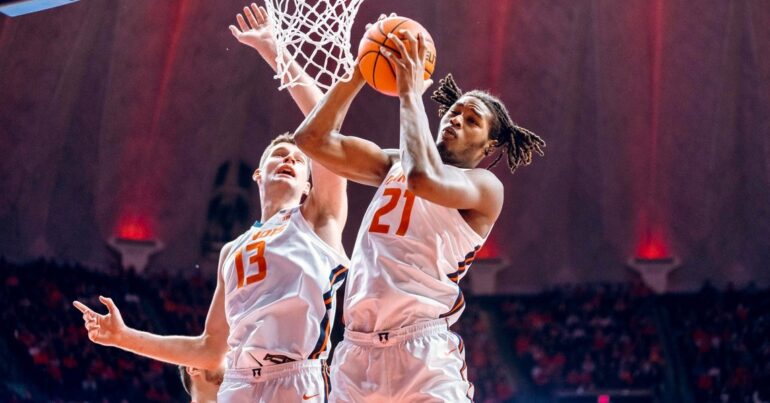
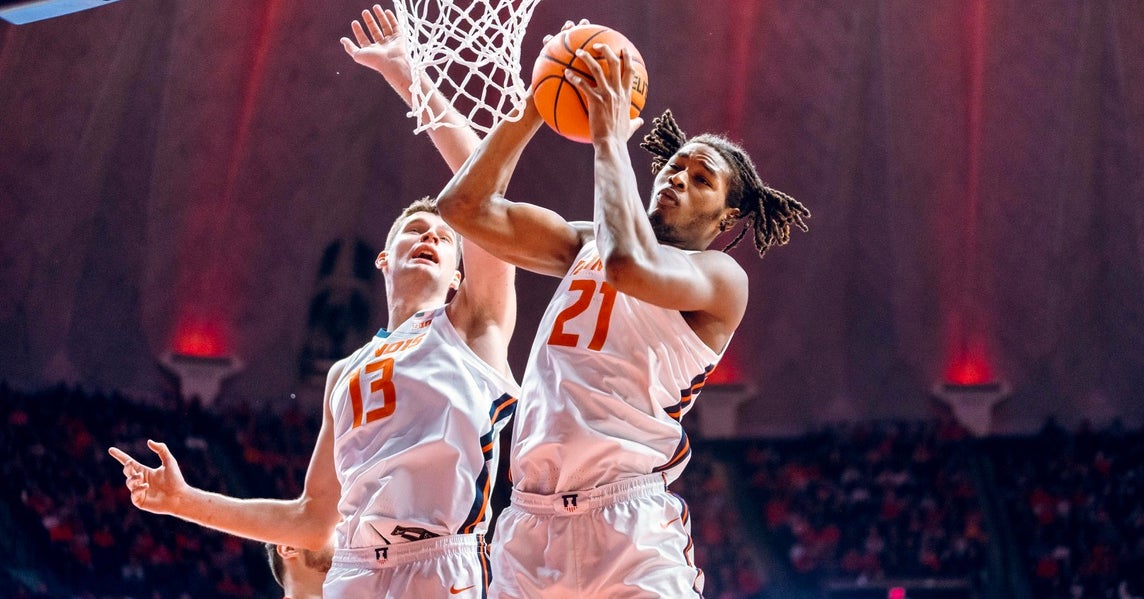
CHAMPAIGN — Brad Underwood made sure to get his longest look at his two-big lineup in Saturday’s 87-79 win over Ohio State, and the Illinois coach said the results were “a mixed bag.”
Morez Johnson Jr. (14 points, 15 rebounds) and Tomislav Ivisic (12 points, 10 rebounds), who returned after missing three games with mono, each recorded double-doubles to help Illinois dominate the Buckeyes on the interior to the tune of a 52-30 points in the paint advantage and a 43-31 rebound advantage.
But the lineup — particularly Johnson, Underwood pointed out — also struggled to slow down Ohio State sophomore forward Devin Royal, who had 29 points (his career-high in a Big Ten game) against the Illini.
Still, playing Ivisic and Johnson — who started together for the first time on Sunday and clearly are two of the Illini’s most impactful players — at the same time played a key role in a needed with for the No. 23-ranked Illini (15-7, 7-5 Big Ten).
“I didn’t care for [the big lineup] much the first 30 minutes and then I liked it a lot the last 10,” Underwood told Illini Inquirer. “I think offensively it gives us a great way to attack five-way switching. It opens the floor a lot and then causes the matchups that allow Morez and Tomi to get a lot of rebounds. So that part of it I really like, and I thought it just created great opportunities for us to get downhill and get back into the paint. So kind of a mixed bag, something we’ve got to continue to grow with. We’ve got enough possessions, so we should be good at it. But now with some tweaks in the lineup, we’ll see how all that continues to grow.”
Ivisic and Johnson barely played together during the first few months of the season. During the Illini’s first 18 games when both Ivisic and Johnson were available, the two big men played only 42:08 together on the court. Yet, the two-big lineup, albeit in a small sample size, was the Illini’s most efficient lineup as Illinois was a plus-55 when those two played together.
Against Ohio State (13-9, 5-6 Big Ten), Johnson and Ivisic played together for 19:42 — almost 14 more minutes than any other game this season — and the Illini were a plus-4 in those minutes. Both were on the court together during the Illini’s key 15-0 run late in the second half that turned a five-point deficit into a 10-point lead — and eventually an Illini win.
“It was good,” Ivisic said. “Morez is physical. When he’s a four-man, he’s got a lot of space in the paint. No one can box him out. He’s going to get every rebound there is. It’s just a different style that the coaches wanted to see for that game. We got many options for lineups, many different combinations that coaches believe that’s going to be the best for that game, and I believe that was the best for that game.”
The Illini seem likely to continue to lean into the two-big lineup moving forward. Underwood is a believer in analytics, and the analytics show the group has been extremely efficient in a small sample — so much so that gaining a larger sample seems the play.
In the 61 minutes Johnson and Ivisic have played together so far this season, the Illini have an elite 49% offensive rebound rate (season team rate is 36.7%) and are shooting 75% at the rim (team season rate is 70%) while opponents are shooting 54.5% at the rim (team season rate is 60.8%).
“Work in progress. We’ll see,” Underwood said of sticking with the lineup changes from the Ohio State game. “We’ll see how things continue to develop. I think we’re comfortable with the fact we have a lot of guys who can play. Our bench has been excellent as it was the other night, that’s important to me always, but we’ll continue to see. It could be something that’s matchup-based. It could be something that we just roll with because we like it, so we’ll continue to grow with that.”
Illini prepared for top NBA prospect(s)
The Illini’s 7:30 p.m. CT Wednesday tipoff between Illinois and Rutgers at Jersey Mike’s Arena likely will draw droves of NBA scouts. The game features three of the consensus top-six prospects in the NBA Draft.
Illini freshman guard Kasparas Jakucionis (15.6 points, 5.7 rebounds, 5.5 assists) has made one of the biggest leaps in his class during the past calendar year, starting with the Lithuanian’s star performances overseas in the Adidas Next Generation Tournament and Nike Hoops Summit and translating to America as one of the best freshmen in the country.
And despite its record, Rutgers (11-11, 4-7 Big Ten) features two of the projected top-three picks in the NBA Draft: Dylan Harper (18.6 points, 4.8 rebounds, 4.1 assists) and Ace Bailey (20.2 points, 7.8 rebounds). Harper is a dynamic, skilled big-bodied guard, while Bailey is an elite scorer due to his combination of length (6-foot-10) and rare ability to make tough shots.
While Rutgers lacks depth — no other player averages more than 7.5 points per game — Harper and Bailey are two of the most talented teenagers in the world.
“Ace is one of the elite hard shot makers in college basketball,” Underwood said. “He’s going to take some, he’s going to make some. You got one averaging 20 and one averaging in 18-19 and they’re going to get their opportunities up. So really, really good players. We’ll treat ’em like we do everybody else in this league that’s capable of getting 20 a night or averaging 20 a night, and we’ve got to be really solid and make their shots contested and difficult.”
However, Harper has missed the last two games with a high ankle sprain, and his status is in doubt for Wednesday’s game. The Scarlet Knights, however, played fairly well without Harper last week. Behind 37 points from Bailey, Rutgers won at Northwestern 79-72 last week and gave Michigan a scare in a 66-63 loss in Piscataway on Saturday, boosted by a combined 34 points off the bench from Jamichael Davis (20 points) and Tyson Acuff (14 points).
Even if Harper can’t go, Underwood is preparing his team for a tough game.
“I mean you lose a 20-point-a-game scorer, you lose a facilitator, you lose one of the elite offensive talents in the country,” Underwood said. “Ace is seeing a little more high volume in a lot of different ways. But I think their other guys, their bench guys have really stepped up. They’ve shot the ball well. They’re playing extremely hard on the defensive side. It’s very hard to be without a guy everybody thinks is the second pick in the draft and then not miss him, but they’ve done a really good job of playing well without him.”
As for the NBA scouts, Underwood said he pays no mind to that and that he doesn’t even address it with his star players.
“We don’t even talk about it. We don’t even acknowledge that exists,” Underwood said. “I’m sure they probably read social media. They’ve got enough of that. We’re trying to win games. It’s about us. It’s always about us. They’re high-character guys. They want to win. And so we don’t even broach the subject.”
Underwood not worried about Jakucionis turnovers
High-usage players like Kasparas Jakucionis are going to suffer turnovers, and the freshman guard’s top-tier playmaking — he is 14th in the Big Ten in scoring and fifth in assists — usually makes up for his miscues.
But Jakucionis has 20 turnovers (to 25 assists) during his last four games while shooting just 4-for-24 from three.
Still, Underwood isn’t making a big deal of Jakucionis’ decision-making. While he’d like some errors to be cleaned up, he also doesn’t want Jakucionis overthinking, potentially negating the great plays the Illini need him to make.
“I don’t mind them as much with the first one, it’s the second one,” Underwood said. “I like his aggressive plays. He’s going to have some of those [turnovers]. I don’t want him thinking about them. He’s a good enough player that he shouldn’t dribble off his foot. He shouldn’t lose the ball. Those are mental carelessness mistakes. But I don’t worry about ’em too much. I really don’t.”
Jakucionis missed two games with a forearm/wrist injury, and the freshman guard continues to wear a wrap over his left forearm. But Underwood said the wrap is “just preventative” and that it’s not the root of Jakcuionis’ turnovers.
“Just preventative,” Underwood said. “He’s great. He’s a hundred percent.”
Heading into the torture RAC?
Rutgers isn’t a basketball powerhouse, though they’ve been a middle-tier Big Ten program recently. And Jersey Mike’s Arena — commonly known as the RAC — isn’t exactly the most stunning arena in the Big Ten.
But during Steve Pikiell‘s tenure (since 2016), the sweaty, tightly-packed trapezoid which holds just 8,000 people has been one of the tougher environments in the conference.
Rutgers has sold out 76 straight regular-season games at home, and is 76-23 at the RAC since 2019-20. The Scarlet Knights are 8-4 at home this season.
Underwood knows the horrors of playing at Rutgers. The Illini dropped three straight in Piscataway from 2020-2022, the last two times as a team ranked in the top 13 of the AP Top 25.
So what makes the RAC so difficult to handle?
“It’s small. 70-some plus sellouts. They’re right on top of you. They are extremely loud and vocal,” Underwood said. “We play in a lot of really big arenas, and this is more compact and tighter and it’s hot. It’s just got an incredible vibe. I love going there. I love getting cussed at things, told how bad I look and it’s awesome. It’s just everything that’s fun about basketball and it’s a great environment, and Coach Pikiell’s done a great job of creating that atmosphere.”