



The college baseball season begins Friday. The sport has never been in a better place. More games are on television. More fans are attending games in person. And the talent level is at an all-time high.
We talked to 10 coaches to get their thoughts on various topics impacting the sport. In Part 1, published on Monday, we asked the coaches to name the best players in the game and identify teams to watch this spring. On Tuesday, in Part 2, the coaches shared some recruiting memories. Who is the biggest recruiting find of their career? What about the one who got away? Today, in part 3, we dive into some hot topics in college baseball — roster size and revenue sharing. And in Part 4, on Thursday, the coaches discuss NIL and the transfer portal.
Here are the coaches:
- Elliott Avent, NC State
- Willie Bloomquist, Arizona State
- Paul Mainieri, South Carolina
- Nick Mingione, Kentucky
- Billy O’Conner, Xavier
- Brian O’Connor, Virginia
- Kevin O’Sullivan, Florida
- Steve Sabins, West Virginia
- Brock Ungricht, San Diego
- Mark Wasikowski, Oregon
It looks like rosters will be cut down to 34 players starting Dec. 1 in 2026 and that fall rosters will be capped at 38 players. Thoughts?
Note: Currently, teams are allowed to have an unlimited number of players during the fall and must be at a maximum of 40 by the first game of the season in the spring.
Avent: I personally think it’s going in the right direction. We had 35 forever, right? Even though it’s hard to practice — like right now we have so many injuries and we’re two weeks from opening day and we can’t (scrimmage) — I understand the necessity of having 34 people. I really do. And I was never one that was a proponent when we went to 40. I always thought that was too many. I understand (having 34) can cause problems when you have injuries. But I still think that this game is going to survive really, really well with 34 people. Although if they want to give you a few more people in the fall for practice — I know basketball has practice squads to scrimmage, and that helps. So it’s going to create some issues. I understand that, but I personally don’t think it’s that big of an issue.
Advertisement
Bloomquist: Long-term, great. But that is a very drastic thing to go from where we were right to 34. I know in the eyes of some, it’s rip the Band-Aid off and let’s get there. We’ve had a lot of high school kids committed for a couple years, right? And now when these rules get thrown at us, somebody’s getting screwed. A lot of these kids are going to get tough phone calls when these rules go into effect. I would have liked it to be more gradual. Unlimited in the fall to 40 right now. I would have preferred something like 42 going down to maybe 37, and then a year later going down to 34. Or something more of a gradual to give us time to trim down.
It’s definitely going to make mid-majors and junior colleges much more competitive because there are some good players that are going to have to get cut just for roster size standards. So I think it’s going to put a lot higher value on a scholarship from a Division I Power 4 program.
Mainieri: I think 34 is a very manageable number for schools, and I personally never had a problem with 35 when it was 35, so I can’t imagine 34 is going to be an issue. But it is more difficult to play intrasquad games in the fall if we don’t have enough position players. Because if you look at a 34-man roster, obviously the biggest priority is to be strong on the mound, and it might take 18 to 20 pitchers to assure yourself that you got 10 good ones, 10 or 12 good ones because of injuries and other things. You lose guys to the draft. You have injuries. Some guys underperform, whatever. And if that’s the case, let’s just say you had 20 pitchers on your staff, you’d only have 14 position players. You don’t even have enough guys to play an intrasquad game, and that’s assuming everybody’s healthy. So that’s the only issue that I would have with it. And if they allow you to have, say, 38 until Dec. 1, then I think that solves that problem. I think that’s plenty.
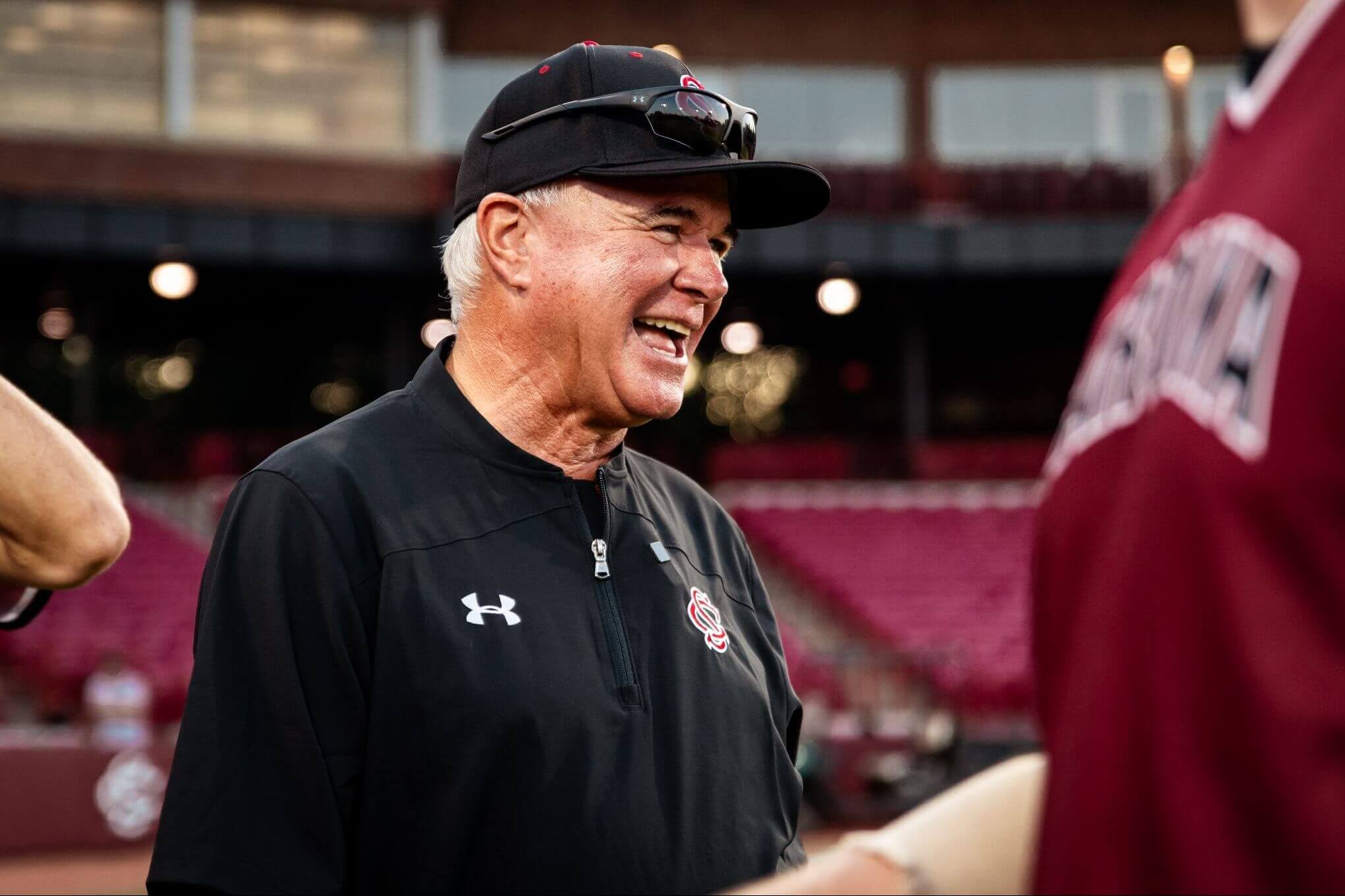
Paul Mainieri has won more than 1,500 games in stops at St. Thomas (D-II), Air Force and LSU. He is in his first season at South Carolina. (South Carolina Athletics)
Mingione: For years in college baseball, one of our biggest challenges has been our scholarship limits to where we only have 11.7. And when you’re sitting across from a family and you know their son is worth a full scholarship, but because of the 11.7, you can’t offer a family what their kid is worth, that has been really hard to navigate. So I love the fact that scholarships are increasing, roster sizes are getting smaller and we’re able to make the overall cost of school for our student-athletes and their families way cheaper. So I’m in love with the 34 and potential 38 (in the fall).
Advertisement
Billy O’Conner: it’s interesting. I don’t know that it’s necessarily good for the game of baseball. Just because injuries are continuing to grow within the game, right? Kids are throwing harder and they’re more likely to get injured. This is going to put more workload on them. We’re playing the same amount of games and we have fewer kids to do it. And they’re going to be asked to contribute in a major way. So I understand the logic and what everything went into it and why it’s changing, but I don’t necessarily agree with it. I think 40 is the right number for a college baseball team. I wouldn’t be opposed to them putting a harder cap in the fall. Because right now, we could have 140 in the fall, but you have to have 40 by the time the season starts. I think it’s a good thing that there’s going to be a cap at the start of the fall because some of these programs bring in 60 or 70 guys, and it’s not creating a good situation for the student-athlete when you’re only there for six weeks or a semester.
It’s changing the dynamics. I think you have less time for development. You have less projects that you can bring in because with a 34-man roster, for the most part, everybody’s got to be able to contribute in some way. It doesn’t necessarily mean they have to throw 100 innings or be the starting shortstop, but you can’t have guys that are unplayable at any point. So you can’t wait for them to be good as a junior. They have to be able to do something as soon as they set foot on campus.

GO DEEPER
College baseball preseason top 25: Texas A&M, Arkansas, Virginia lead the pack
Brian O’Connor: I don’t like it because first and foremost, we’re taking away, in Division I college baseball, we’re taking away 1,800 opportunities for young men to be Division I college athletes. Think about the magnitude of that — 1,800 opportunities by going from 40 that we have this year to 34 next year.
We just had our 10-year reunion of our national championship team, and you hear those guys talk, whether they played and then went on to the big leagues, which 10 of them did, or they didn’t play very much. Where they are now, 10 years later and the life lessons they learned from being a Division I college athlete, every day the grind and the teamwork and everything that we know that college athletes get, the fact that we’re taking away 1,800 opportunities is why I don’t like it.
O’Sullivan: I have been a big fan of it. I didn’t see a real issue with the 40-man roster. I would have liked to have just seen a hard number. If the number is 40, then you have to start in August at 40. Because I think, ultimately, what you’re going to end up seeing is we’re going to end up putting even more pressure on our pitchers because of the fewer numbers. I don’t think that’s in the best interest from a pitching standpoint. The less of the numbers, the more the workload.
Advertisement
I don’t spend a whole lot of time complaining about it because the rules are the rules and when they change, they change. But I do think adding the four extra players in the fall at least gives you some flexibility if a couple guys go down with injury, that you can add a couple of arms so you can at least get to your 34.
Sabins: Less opportunities across the country. Coaches are going to recruit older players in general because there’s less misses with older players and experienced players. If there’s a roster cap that is greater than the number of players allowed in the spring, there’s still going to be a group of players that are told that they’re not going to make a roster. So what happens with those players if the intentions are for coaches to not cut players or to not upset players or to not have too many players to start the fall? There’s still so many things to work out.
I guess I’m a little confused about what the true intent is of the rule. Some people have brought up the fact that they don’t want to be sued for letting too many players go at Christmastime because players can’t transfer (from) D-I to D-I. Others have said it’s based on resources. We don’t want to have too many players in the fall because it’s expensive and those are resources used that aren’t invested into the players that will then go on to the spring semester. So I think there are a lot of moving pieces.
It seems reasonable to me, though, that if we’re looking for parity in college baseball and you want to have some sort of evenness between some of the top teams, that some sort of fall roster cap exists so people are starting camp essentially with a certain amount of players and then they’re moving into more of a competition mode in the spring. But you’re going to limit opportunities by doing that and some of the best players won’t have the opportunities at some of the best institutions with the greatest resources because of that. So high school talent will be more dispersed across the country at different levels, and the schools with the most resources and finances will invest in more proven commodities.

GO DEEPER
College baseball preseason superlatives: Golden Spikes watchlist, top transfers and more
Ungricht: I like it. All for it. I think it really puts the pressure, in a good way, on college coaches to, in the recruiting process, have candid conversations, have honest conversations with families, which families deserve, so that the over-recruiting era is going to be gone.
You’ve got to be definitive on your player evaluations. It’s going to put a little bit more discipline on coaches, too, to have those conversations with families and players. And I think there’s going to be more of a sense of reality (for the) kids, too. Like not everyone’s going to be able to get the opportunity to play Division I baseball right off the bat. Junior college is probably going to become more prevalent like it used to be where if these high school kids want to continue their playing careers, they’re going to need to go to junior college or pick another route. I think it’s going to be good for that. I think it’s going to be good for the game.
Wasikowski: I don’t like the concept of minimizing rosters because it’s minimizing opportunities for players. If we’re going to cap rosters, I was an advocate to cap rosters at 40. I think 40 was good. I think that allowed you a chance to be able to have enough pitchers on your pitching staff to weather the storm of injuries and be able to play scrimmages. And I think anything less than that gets into a place where you’re playing managers during scrimmages because you don’t have enough bodies or you have the risk of not having enough pitchers or maybe even extending a pitcher when you shouldn’t extend them because you just don’t have enough guys because of potential injury or something like that. I don’t think in baseball you should be limiting the numbers to 34. I think that’s too rigid.
Advertisement
With the impending House settlement, schools can choose how much of the $20-plus million they want to share with each sport. Do you anticipate revenue-sharing payouts for baseball being equitable across your conference?
Avent: I’m afraid it won’t be. I don’t know. I think the unknown right now is what’s keeping us all kind of awake at night a little bit, so to speak. You can plan for anything if you know what you’re dealing with. It may be difficult, but it’s better to know what you’re dealing with and plan for it than not to know. And right now to answer your question, none of us know what’s going to happen, but I do think there’s going to be more disparity between teams and leagues and teams throughout the country than there’s ever been, which I think is going to change college baseball.
Bloomquist: I don’t think there is going to be one school out there that is going to blow the doors off of the other schools in our conference (Big 12) because I think there is such a premium on football and basketball to get such a lion’s share of that. On the other hand, if you have an AD who is very aggressive toward baseball, you can really make some waves and make some splashes in your conference and throughout the country if you were able to have some sort of competitive advantage in revenue sharing. A lot of it depends on how many sports each institution has and how much of that pie can we divvy out to different sports. I know our athletic director here has been very bullish on baseball and I think there will be some news coming out shortly on that front. I feel like we are in a good place with our program.
SCOOP: @ASU_Baseball intends to go all-in on the scholarship front in college baseball, and is expected to offer 34 full scholarships beginning in 2026. #ASU also will participate in revenue sharing for baseball, and will do millions in improvements to PHX Muni in the offseason.…
— Kendall Rogers (@KendallRogers) February 6, 2025
Mainieri: I sure would hope so. I mean, that’s why you’re in a conference, is to play on a level playing field. And when it comes to scholarships and rev share, I hope that it’s the same.
Mingione: That part, I have no idea. I really quite frankly don’t know what to expect, but I do believe there will be some (money) for our sport across the SEC.
Billy O’Conner: I do because I think they’re all going to be zero. I think very, very few conferences or programs or athletic departments are going to allocate any of that money for college baseball. Maybe a small portion, but it’s probably the same programs that are already allocating a large number for NIL. You’re talking SEC, maybe some of the top of the Big 12, maybe a couple at the top of the ACC, but that’s probably going to be, very few Big Ten even, but that’s going to be the extent of it. There’s so many mouths to feed with this thing.
Also, with the Title IX part, that seems to be going into it — with every male dollar that’s paid out, you have to pay out for female dollars. At the end of the day, football and men’s basketball are going to be the driver here. For them to willingly take resources away from those two sports, I don’t think many athletic departments are going to make that decision that they care about baseball that much to detract from what they’re doing from a football and a basketball standpoint, just because that’s where the TV revenue comes from.
Within our conference (Big East), to me, it’s not really a concern. I doubt that many, if any, will have any sort of revenue-sharing money that they’re going to be able to get out to their baseball programs.
Advertisement
Brian O’Connor: I do not. I do not see it being equitable at all. And so I think overall, I think you’re going to see even a farther gap widening, in leagues and in all of college baseball. So the question is, is that really what’s best for college baseball? It is what it is, and I’m not complaining about it, but I think you’re going to see, just in the ACC, wide gaps between what teams have for player acquisition and player retention. We’ll see how it plays out the next couple of years. But under no circumstances do I believe that it’s going to be equitable at all.
O’Sullivan: I don’t have an answer to that right now. I know every school is going to be a little bit different in terms of one school may have 25 full scholarships, another school may have 34. One school may stay at 11.7 for all I know. As far as the revenue sharing, that’s going to be a school-to-school basis. It’s certainly not going to look like what it has been the last couple of years.
Sabins: At this point, I don’t. But I think there’s only been one school in our league that has come out and talked about what that number looks like specifically for them and that’s Texas Tech. So I don’t think that has happened for a reason. I think there’s some strategy on the AD’s part to really understand what’s happening. It appears in this current landscape the longer you wait, sometimes the better you are because there are so many moving pieces, and one of the biggest ones has to do with the NIL space. They’re looking for a third-party arbiter basically to deem whether NIL contracts are fair market value or not.
And so if they can’t figure out how to control NIL payments to players, I think a lot of these ADs are going to change how they want to use their $20 million because certain institutions have so much support through NIL that some of the ADs may be able to help some of the Olympic sports or the smaller-revenue creators or revenue losers with some of this revenue share.
Ungricht: I doubt it. I think it’s going to depend on, obviously, these ADs if they really want to put their foot forward and opt-in first, right? And then the good thing about our conference (WCC) now is that we’re all private schools, so the cost of tuition, cost of attendance is all pretty much — they’re all within range of each other. So that makes it very equitable. I think some are going to opt in and some aren’t, to be honest.
Wasikowski: I haven’t heard enough to comment yet on what the Big Ten’s plans are as a collective unit, as a conference, and what rules they’re going to impose on conference members to be able to adhere to. I haven’t heard enough about what the plans are. I know Tony Petitti, our commissioner, is a big baseball guy. He was an MLB executive. He’s a baseball mind, and so he’s going to have a baseball desire, but I haven’t heard anything specific yet out of the conference to be able to comment yet.
(Photos of Billy O’Conner, Nick Mingione: Courtesy of Xavier University, University of Kentucky)