

The first phase of the Tennessee football program’s 2025 offseason is in full swing with the Vols beginning winter strength-and-conditioning workouts last month and spring practices still a few weeks away. After securing its first-ever College Football Playoff berth but exiting quickly in a humbling first-round defeat to eventual national champion Ohio State, Tennessee is looking to position itself again to contend in the SEC and nab a spot in the 12-team bracket in its fifth season under head coach Josh Heupel in 2025. With the Vols already working toward the fall every day, it’s a good time to assess the state of Tennessee’s roster and the outlook at each position.
That’s exactly what GoVols247 will do this month in its annual Offseason Outlook series, which will break down every position on the roster by examining who the Vols lost and who they have, the players who need to step up and the pressing question for each unit.
After rolling through the offense (QB, RB, WR, TE, OL) and the defense (DL, LB, CB, SAF), the series wraps up with special teams.
WHO’S GONE
Tennessee will have a new face starting the operation on punts, field goals and extra points next season for the first time since the 2020 opener. Salansky, the walk-on from Morristown, Tenn., took over the long-snapping duties midway through the first game of the pandemic-impacted season at South Carolina and never looked back, and was pretty close to flawless over the five seasons in the job. The two-time Burlsworth Trophy nominee played in 62 career games, executed 595 total snaps (90 on field goals, 263 on PATs and 242 on punts) and had nine tackles in punt coverage during a career that spanned Paxton Brooks and Jackson Ross at punter and Brent Cimaglia, Chase McGrath, Charles Campbell and Max Gilbert at kicker.
Bennett Brady is expected to take over for Salansky, the redshirt junior having snapped in three games in 2023 and in four games in 2024.
As far as returners go, we’re including any players that had multiple returns last season. Seldon started out as Tennessee’s primary kickoff returner last season and had three returns for 77 yards. White recorded seven of his 10 career punt returns last season, and had 112 total yards (16-yard average) with returns of 20, 31 and 22 yards in the first three games.
WHO’S HERE
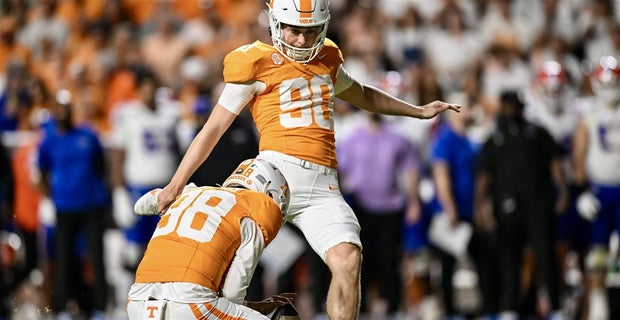
The Vols return all three of their primary specialists and a star in the return game with Carter.
Ross, the Aussie who can punt with both feet, continued to be a weapon in the field-position battle for Tennessee thanks to his prowess of pinning opponents deep in their own territory. On 53 punts in 2024, he averaged 43.9 yards with 10 of 50+ yards, produced 15 fair catches and pinned opponents inside their 20-yard lines 21 times. The Vols were top 30 nationally in net punting.
Turbyville was an All-SEC selection as a kickoff specialist thanks to his powerful leg, which produced 68 touchbacks on 82 kickoffs with improved accuracy (just two out of bounds after he put six out in 2023).
Gilbert was 20-of-26 on field goals and made all 54 extra points as a redshirt freshman in his first season as Tennessee’s kicker. Three of his misses came in one game (Kentucky), and he responded a week later by making all four, including a then-career-long 51-yarder, against Mississippi State and then nailing a 52-yarder at Georgia. Gilbert was 7-of-12 from beyond 40 yards and 3-of-6 from beyond 50 yards.
Carter was a difference-maker when the Vols finally put him back deep to return punts after turns by White and McCoy (six returns for 59 yards). He totaled 198 yards on 12 returns for the season, but in a three-game stretch in November he had 10 returns for 143 yards and set up multiple scores and scoring chances. Carter was the return specialist on the SEC All-Freshman Team.
Lewis took over the kickoff-return duties the second half of the season and had 151 yards on seven returns.
WHO COULD STEP UP
Special teams have provided an early path to the field for Tennessee’s freshmen throughout Heupel’s tenure, and many of them have used it as an avenue toward greater playing time at their primary positions, particularly on defense.
Then you also have Will Brooks, a special teams fixture as a walk-on who used those reps as the runway to what he did as a starting safety last season.
Tennessee’s freshman class is loaded up at linebacker and in the secondary, and there’s some skill players on offense who could vie for roles on those return and coverage units, too. The Vols believe there are a lot of techniques on special teams that are translatable skills to offense and defense, and those full-speed reps give players a chance to expedite their adjustment to pace and space of the game at the college level. So don’t be surprised if several freshmen wind up covering kickoffs and punts or blocking for Carter next season, and there are some candidates (Daune Morris and Radarious Jackson come to mind) who will join the competitions at the return spots.
PRESSING QUESTION
How does Tennessee’s new coaching setup impact the play on special teams?
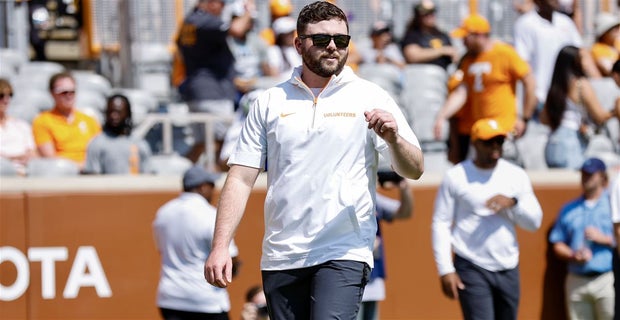
The Vols overall have been pretty good on special teams under Heupel with reliable execution from its kickers and punters and big plays from its punt returners throughout the past four seasons. Mike Ekeler had a lot to do with it with his general fervor for those units and his ability to identify and recruit the likes of Ross and Gilbert, who have been good in their roles. But he returned to Nebraska this season, and Tennessee made two moves to replace him: The Vols elevated analyst Evan Crabtree to special teams coordinator and hired veteran NFL special teams coach John Bonamego as assistant special teams coach.
On the surface, it looks like a brilliant move, and it shows how much Heupel values maintaining the standard on special teams. Tennessee maintains continuity with Crabtree, a former long snapper, having been on the staff as a graduate assistant and analyst the past three seasons, so he’ll know the personnel and what skill sets certain players have that translate to those roles on coverage and return units. Then Bonamego was a special teams coordinator in the NFL for the better part of two decades for several franchises and obviously can bring his experience to practice drills, game-planning and strategizing ways to find that spark on Saturdays.
Rarely do you see a team competing at the top end of college football be bad on special teams. Usually it’s your middling teams who have issues making little mistakes in the third phase of the game. Think back to the Florida game last season when a substitution snafu cost the Gators three points at halftime in an eventual overtime loss.
Tennessee has a lot going for it in the kicking game with the specialists that are returning and in the return game with Carter such a threat, but the Vols certainly can improve on special teams. They allowed a kickoff return for a touchdown against Vanderbilt, and two long punt returns nearly cost them in the fourth quarter against Florida. The Vols committed 14 penalties on special teams in 2024 – double their 2023 total – and none were bigger than the drive-extending running-into-the-punter flag on Jordan Ross in the Arkansas loss, and they also blocked just one kick/punt after recording eight blocks the previous three seasons.
The Crabtree-Bonamego tandem has a lot to work with and must continue striving for an edge on special teams. The advantage there can go a long way toward winning on Saturdays. After all, this is the program of Gen. Robert Neyland, whose game maxims included this one: “Press the kicking game. Here is where the breaks are made.”