
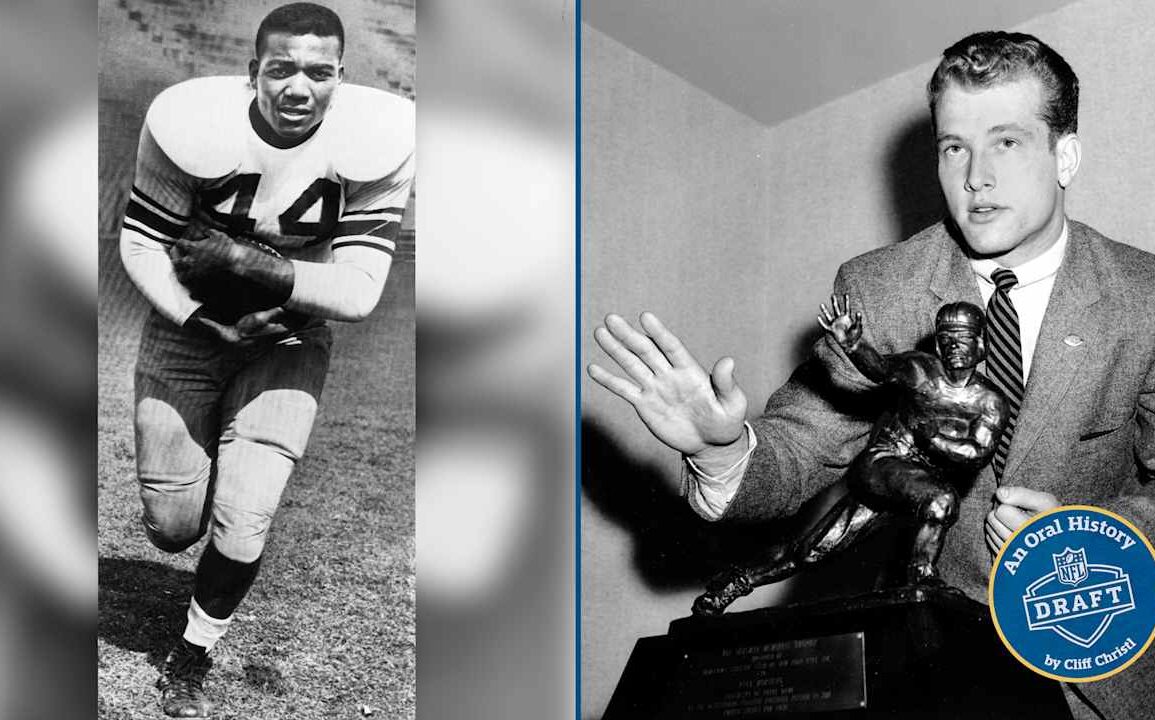
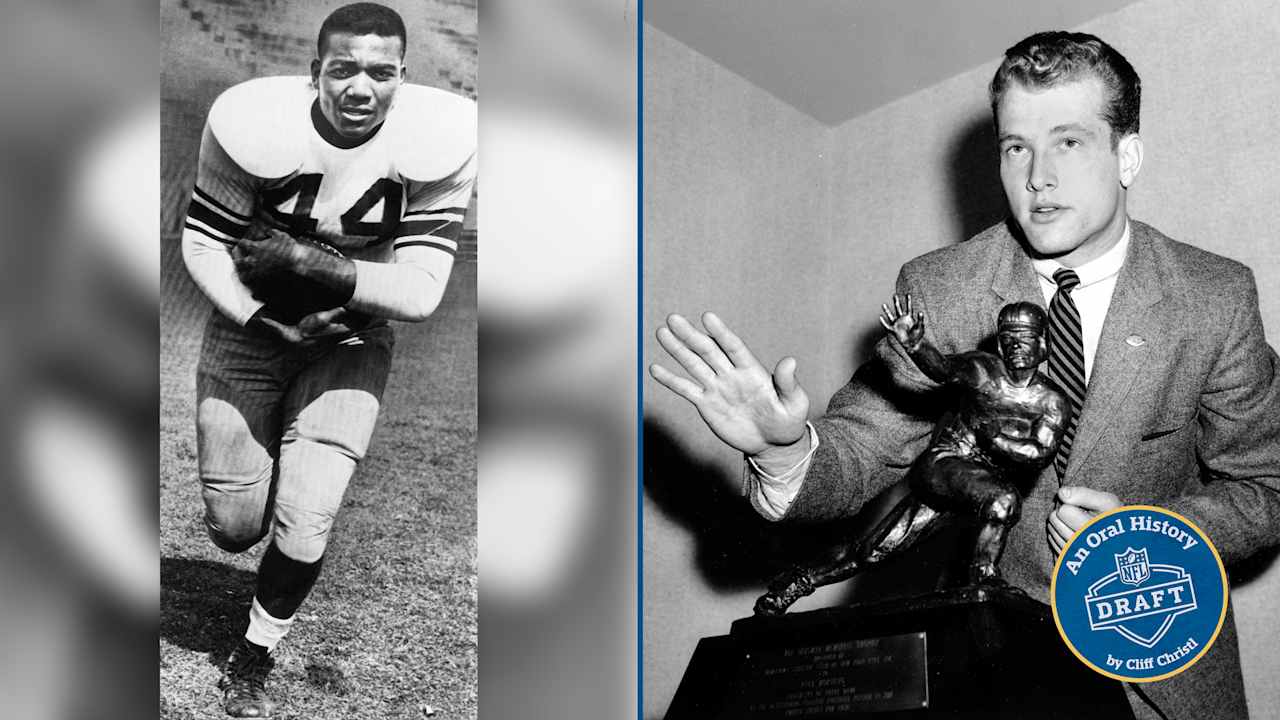
Green Bay’s bonus pick: Hornung or Brown?
Five days before the start of the 1957 draft, Vainisi spoke to the Packers’ Quarterback Club, a weekly in-season gathering of fans held at the WBAY auditorium in downtown Green Bay. During his talk, he said based on reports from 22 college coaches across the country, there were six players under consideration if the Packers won the bonus pick.
Here was his rundown.
Vainisi: “Kramer (6-3, 216) and Hornung (6-2½, 210) are the two finest athletes in college football today. Kramer has only one weakness. He’s overanxious – he likes to kill people, which could cost you 15 yards now and then. Hornung is considered the greatest athlete in Notre Dame history.”
Vainisi on Arnett (5-11, 190): “The greatest running back they’ve ever had – even better than the (New York) Giants’ Frank Gifford.”
Vainisi on Brodie (6-1, 192): “A tremendous short thrower. (He) is from a wealthy family and not sure he’d like the hard knocks of pro football.”
Vainisi on Peaks (6-1, 218): “(He) is the finest back in the Big Ten – a big fellow… Only question mark with him is the fact that he has had knee surgery recently, but his doctors say he’ll completely recover.”
Vainisi on Brown (6-2, 212): “A great football player, perhaps the No. 1 back in the country.”
Vainisi also offered one other evaluation: “Dawson has tremendous pride in his ability and is without a doubt the best passer in college football. But he won’t run with the ball. He has patterned himself after Otto Graham, and it is very likely the Cleveland Browns will draft him.”
Meanwhile, the same night as Vainisi’s talk, Milwaukee Sentinel sportswriter Bud Lea interviewed Blackbourn in Detroit, where he was awaiting the Packers’ annual Thanksgiving clash against the Lions.
Blackbourn left Lea with the impression that his choice would be either Hornung or Brown.
Blackbourn (Milwaukee Sentinel, Nov. 25, 1956): “This Hornung can do so many things well. He can pass, run, kick and could be a good defensive halfback. And Brown of Syracuse has the size and speed – the kind of a halfback we need.”
The morning of the draft, the Packers won the bonus pick, when Blackbourn pulled the lucky slip of paper out of NFL Commissioner Bert Bell’s hat.
Why did the Packers draft Hornung over Brown or any of their other four finalists?
Blackbourn (Press-Gazette, Nov. 26, 1956): “He has the greatest potential of all Notre Dame backs. He is a great natural athlete, a tremendous competitor, has great speed and will stand the type of punishment dealt out in the league. … He has wonderful poise and we believe in one year he will become an excellent passer. He also is quite versatile and can be used as a fullback, halfback or quarterback. Hornung is the Tobin Rote type of back, and he’ll fit into the Green Bay pattern nicely.”
Vainisi also favored Hornung’s selection and had gathered a stack of favorable scouting reports on him, including one from a 29-year-old, first-year assistant coach at Notre Dame named Jim Finks.
Finks, future Hall of Fame general manager (Green Bay Packers scouting report, 1956): “Needs work on his passing as I reported last spring, but I feel sure he could develop into a fine passer. Real good runner & exceptional speed. I feel Paul is the best prospect I’ve seen. Could play halfback or fullback as well as QB.”
Despite playing on a Notre Dame team that had finished 2-8, Hornung won the Heisman Trophy and finished second in the country in total offense with 1,337 yards.
But what seemed to have impressed the Packers more than anything was Hornung’s overall athletic ability, something much more valued at the time by scouts than it is today. He was described as a quarterback “who plunges like a fullback” and possesses the “open-field instinct of a halfback.”
In fact, after drafting Hornung, Blackbourn admitted that he wasn’t sure where he’d play him. He said that at Notre Dame, Hornung had played quarterback, halfback and fullback on offense, and safety and cornerback on defense.
As a senior, Hornung played mostly quarterback and safety in the one-platoon era (1953-63) of college football. In the process, he led the Irish in scoring, rushing, passing and kickoff returns with a 31-yard average. He also finished second in tackles and had led the Irish in interceptions as a junior with five.
Philadelphia scout Bucko Kilroy on timing Hornung at the East-West Shrine Game (Sports Illustrated, Aug. 10, 1998): “Hornung ran the 50 against Abe Woodson, the Big Ten hurdles champ from Illinois. When you think of Hornung, you don’t think of him being that fast. Hornung beat him by five yards.”
Hornung also had lettered in basketball as a sophomore, averaging 6.1 points per game.