




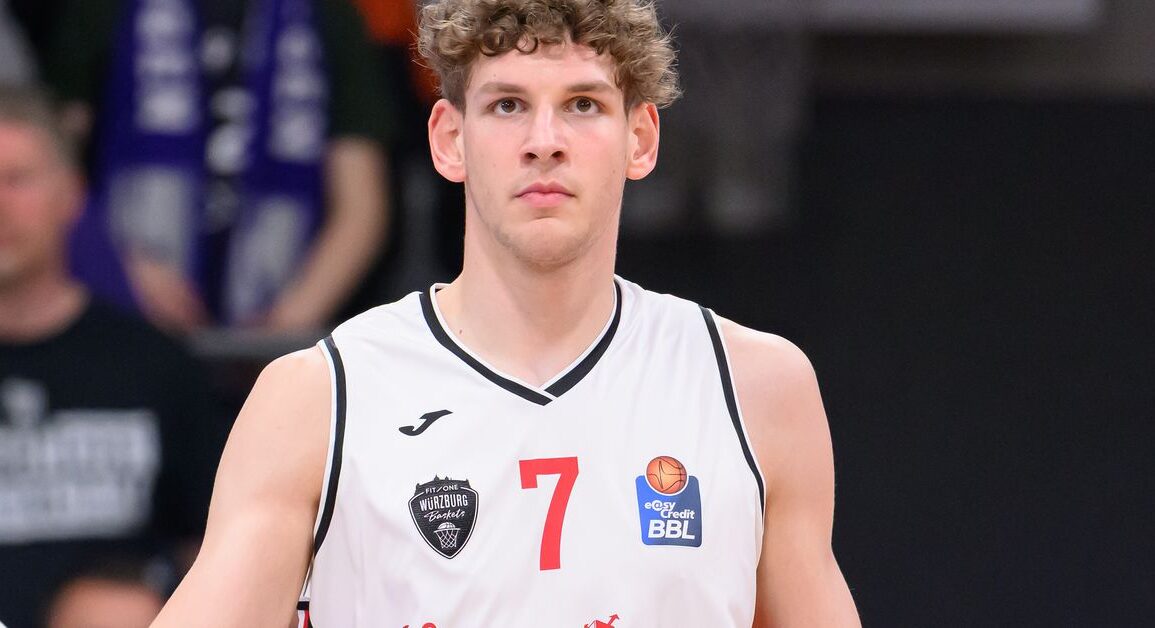
Washington recently announced the official signing of German big man Hannes Steinbach. Listed at 6’9, Steinbach is currently averaging 7.1 points and 5.5 rebounds per game playing for the Wurzburg Baskets in the German Basketball Bundesliga (BBL).
Understandably, most college basketball fans don’t know what to make of that kind of information. What level of competition is the Bundesliga? How does that compare to high major college basketball in the US? How impressive is it for Steinbach to put up those numbers?
We are seeing more and more European players coming to the States to play in college with the college game rapidly resembling a professional league in terms of reimbursement. That means it will be more important for college fans to get a sense for what should be considered impressive over in Europe.
In the meantime, most college basketball fans will probably fall back upon the type of information sources that we know. Namely recruiting rankings. Steinbach isn’t rated yet though by any of the major recruiting services. That will probably change. 247 Sports usually gets around to rating top international prospects. Projected 1st round picks in the upcoming draft Khaman Maluach (Duke), Egor Demin (BYU), and Kasparas Jakucionis (Illinois) were all ranked in the top-36 in the 247-only rankings for this past season even if other services didn’t get around to them.
If 247 Sports ranks Steinbach next week and he debuts as a top-25 player in the country then Husky fans will obviously get extremely excited and completely change their viewpoint of what to expect.
But that might be a while.
German Bundesliga Competition
So let’s try to assess Steinbach’s accomplishments before that happens. Here’s what Steinbach’s full stats look like right now:
25 games played, 18.1 minutes, 7.1 points, 5.4 rebounds, 0.7 blocks, 65.1% FG, 33.3% 3pt
He is doing all of that while 18 years old (turns 19 on May 1st). It is not common for an 18-year old to be playing at that level. A quick look at Steinbach’s roster makes that clear. Steinbach is currently 7th on the team in minutes played and every other player ahead of him is at least 26 years old. Despite that, Steinbach is 4th on the team in points, 2nd in minutes, and 1st in blocks.
Most of the players on Steinbach’s team’s roster are former college players. Their point guard is Jhivvan Jackson who averaged 22.2 points per game over his college career in 4 seasons at UTSA. Their other primary PF/C is 33-year old Canadian Owen Klassen who averaged 16 ppg, 9 rpg playing for a Canadian college over a decade ago. The two most familiar names for college basketball fans are likely Davion Mintz (Creighton/Kentucky) and Aubrey Dawkins (Michigan/UCF).
There may not be any similarly young players on Steinbach’s own team but maybe they’re common on other squads. Let’s check.
Steinbach is 8th in the league in rebounds per 36 minutes among those playing at least 17 minutes per game at 10.9 boards. All of the top-8 players are all between 6’9 and 7’1 in height. Everyone else in that grouping are between 24 and 33 years old. Steinbach is the youngest of the pack by far.
Using the per 36 totals, those 8 players are averaging between 10.4 to 18.9 points and 0.3 to 1.4 blocks. No one in the group is averaging more blocks than Steinbach and he is in the middle of the pack at 14.2 points per 36 minutes. But it’s worth noting that Steinbach is also 2nd among the group in FG% and the only one to semi-regularly make a 3-point shot at 33.3%. It’s safe to say that Steinbach is one of the most well-rounded and efficient players among the top rebounders in the BBL despite being substantially younger than his competition.
Most of the other players in this group of top rebounders are international players but there are 2 who played in college in the USA. One of those you’ll probably recognize and the other you probably won’t.
The overall best rebounder in the league is former Bowling Green center Deamajeo Wiggins. He was also one of the best rebounders in college basketball and averaged 12.5 points and 10.6 rebounds per game in 2018-19 playing in the MAC and is now 27 years old. He was 6th in the country in defensive rebounding rate that year and 214th in offensive rebounding rate.
The other name which is more recognizable is David McCormack who played at Kansas. McCormack is now 25 but started for the Jayhawks as a senior when they won the national title in 2021-22 averaging 10.6 points and 7.0 rebounds per game. McCormack was a bit the opposite of Wiggins in that he was a monster on the offensive glass instead (5th in OR%, 299th in DR%).
Either way, Steinbach is putting up comparable numbers right now to guys who were elite rebounders in college 3-6 years ago and should now be squarely in the peak of their athletic careers.
Other Recent Comparisons
I have recently been combing through my database to try to find apt comparisons for recent Husky transfers based on their performance at other schools. I wish I could go through and do the same thing to compare Steinbach to a bunch of other players who played in the Bundesliga at age 18 and then came over and immediately played in college.
Unfortunately, there just aren’t very many examples to draw upon. I went through 247’s rankings for every international recruit they’ve had over the last decade or so and very few of them have come from the BBL to college.
- 6’6 SG/SF Fedor Zugic is from Montenegro but played in the BBL in 2024 at age 20 and averaged 10.8 points per game. He committed to Creighton as an unranked prospect and as a freshman this year missed the first half of this past season due to injury. Zugic came off the bench upon his return and averaged 4.5 points per game for a tournament team but did so on really good efficiency numbers.
- 6’11 C Mortiz Wagner was the #47 overall prospect per 247 Sports but ranked 119th in the composite as other sites were lower on him. He played in the BBL but only appeared in 4 games where he averaged 2.3 ppg before coming to college. Once Wagner got to Michigan he started off slow and only played 9 minutes per game as a freshman. He became a double digit scorer as a sophomore and junior and in his final year in college helped lead Michigan to the national title game before becoming the 25th overall pick in the NBA Draft.
- Wagner’s younger brother 6’7 SF Franz followed a similar path. He played a little more extensively in the Bundesliga averaging 4.6 points in 12.4 minutes per game for his team. That helped Wagner win the BBL “Best German Young Player” award. Franz followed in his brother’s footsteps to Michigan and was an immediate starter. Wagner averaged 11.6 points and 5.6 rebounds per game as a freshman which climbed to 12.5 points and 6.5 points per game as a sophomore before becoming a top-ten NBA draft pick.
We will see whether Steinbach also wins a “Best German Young Player” award once his season ends in a little while but if he does then he is on a similar track to Franz Wagner. Steinbach’s numbers in the BBL are more impressive than Wagner’s were at roughly the same age (Steinbach is about 3 months older than Franz was at the same point in their careers).
Another data point worth noting is that former German-born Stanford star Oscar da Silva averaged fewer points and rebounds per game in the BBL immediately after graduating than Steinbach is right now. Da Silva had averaged 18.8 points and 6.8 rebounds per game at Stanford and was a 2x All-Pac-12 1st Team player.
There are folks out there on social media who really follow international competition that suggest Steinbach is an elite player who has NBA potential. It doesn’t seem completely outlandish if Franz Wagner is actually a reasonable comparison.
It’s worth keeping in mind that there are greater differences between college and domestic European leagues than just the level of competition. FIBA rules and the way the game is played has a substantial adjustment period. That’s part of the reason the USA always seems to struggle in International events more than they should given their requisite talent. Steinbach could easily get to Washington and need a year to adjust to the style of play.
It’s probably safest for now not to put significant expectations on Steinbach’s shoulders but it also wouldn’t be surprising if Steinbach arrives on campus and immediately wins a starting spot.
If this were happening a year later then we would potentially have one more test case to look at. Louisville has a commitment from German center Sananda Fru who is currently 247 Sports’s #25 overall prospect. Fru is averaging 12.8 points, 5.7 rebounds, and 1.4 blocks per game in the BBL this season as a better scorer/shot blocker than Steinbach. The reason that’s not a great comparison though is that Fru turns 22 in August. He’s much more akin to a grad transfer than he is a high school prospect.
As an 18-year old, Fru averaged 1.8 points and 1.1 rebounds in the BBL and only last year as a 20-year old did he start to receive similar playing time to what Steinbach does this year. It will be interesting to compare the two of them and see how they fare in the States. If Steinbach keeps up his current developmental curve then he will probably be a better college player in 3 years than Fru will be this year. But there’s a good chance that Steinbach is instead in the NBA by that point and we never get to compare their age 22 college seasons side-by-side.