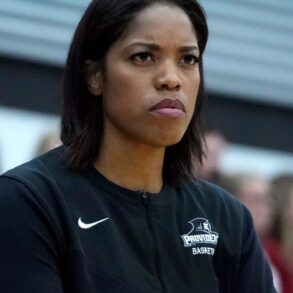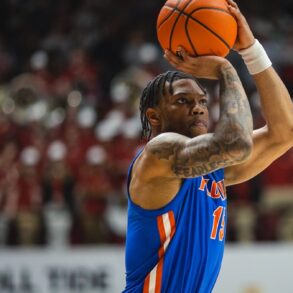




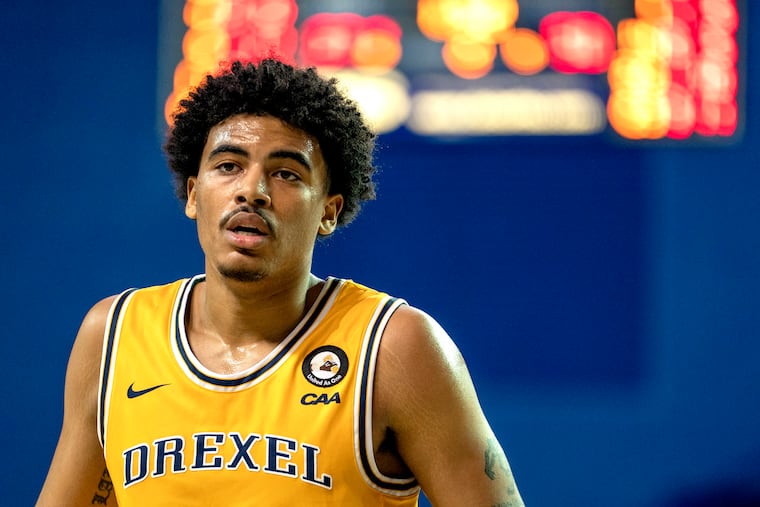
Starters Yame Butler, Kobe MaGee, and Cole Hargrove entered the transfer portal after Drexel’s men’s basketball season, and all found landing spots at major programs.
Butler and Hargrove committed to Butler and Providence, respectively, in the Big East and MaGee committed to Florida State in the Atlantic Coast Conference.
» READ MORE: Recent player movement in the Big 5 and beyond shows the gulf-sized gap between the haves and have-nots
Behind the entities in those transactions, you may not know the two advisers helping to facilitate those players’ moves. R&R Advisory Group, run by Ricky Goings and Kareem Rush, helped the trio of Drexel transfers find their new basketball programs, and they have been helping student-athletes maximize their college basketball careers for nearly a decade.
Goings, whose day job is working in the office for youth programs in the Department of Employment Services in Washington, D.C., started R&R Advisory Group alongside Rush, a former player at the University of Missouri, to utilize their deep connections in the AAU and college basketball community.
The goal? Align student-athletes with revenue-generating opportunities.
Initially, the focus was on securing transfer waivers for players in the days before the transfer portal. Now, Goings and Rush are focused on helping athletes secure lucrative compensation through name, image, and likeness deals, and revenue sharing.
» READ MORE: NCAA transfer portal: What it is and how it provide leverage for the college athlete
In the new world of college basketball, the most coveted offseason additions to major programs are not necessarily the top high school players, but the top players from the low- and mid-major ranks. That’s where Goings and Rush enter into the equation.
“High majors are looking for experienced college players on that mid- and low-major level,” Goings said, “so they reach out to guys like me who have their ears to the ground and who have experience in identifying successful players whose games translate to the high-major level.”
Once R&R Advisory Group sees interest in its players from major schools, it goes to work negotiating the financial terms with the programs.
Goings stressed that he is not an agent but more of a business adviser. As such, he feels that schools are more honest with him at the negotiating table.
“You have to separate what’s real from what’s fake,” Goings said. “Because I have long-standing relationships with these coaches, and they’re not looking at me as an agent, they know I understand the market. So the coaching staff is very honest with me about what they have to pay for certain positions.
“Once we agree on the number, then we have to work out, ‘What are some incentives? How do we include a car deal in that? Does somebody’s mother want to relocate?’ All that stuff factors into the equation. Once you agree upon the number and the terms of the players, now it’s all about the logistics of payment dates.”
In the case of MaGee, Butler, and Hargrove, Goings said the trio’s combined financial compensation will be $1.325 million.
“Once we agree on the number, then we have to work out, ‘What are some incentives?’”
When fans of mid- and low-major teams see financial figures like that, it is common for them to mourn the era of college basketball when the “have nots” could compete with the “haves.”
Goings believes this fear is misguided, however, and he says that with the House v. NCAA settlement on the horizon, Cinderella runs will become possible again.
“Revenue sharing is actually going to allow mid-majors to compete,” he said.
“Do you want to be a role player for an amount of money at a high-major or do you want to be the man at a mid-major for a little bit more money?” Goings said. “I think revenue sharing is actually going to level the playing field a little bit more. If you’re a sophomore at a high-major and you’re making an amount of money but you’re not playing, you’re not going to get that same money the next year unless the coach is planning on investing in you again, which might not happen.
“So, now you have a mid-major that will pay you comfortably to have a bigger role. You’re going to see a lot of three-points-per-game, high-major guys take $350,000, $450,000, $550,000 at a low or mid-major and get that team to the tournament.”
For those who think the transfer portal and player compensation have swung too far in player empowerment, Goings does not believe there will be restrictions imposed anytime soon.
“The function of our economy is that athletes have a certain amount of value,” he said. “The NCAA cannot legally justify an amateur model, and that is why they have lost so many lawsuits. They make billions, the school is making millions, and the players were making nothing. But the entire existence of the NCAA’s revenue is derived from these players.”
“The NCAA cannot legally justify an amateur model, and that is why they have lost so many lawsuits. They make billions, the school is making millions, and the players were making nothing.”
Could there be more changes on the horizon? Goings sees the NCAA potentially being unable to stand in the way of “five-year eligibility and even less restrictions of transferring,” as well as some Title IX challenges.
“I think that what you’re going to find with regulations in college sports is you don’t just get to regulate stuff because you say so,” Goings said. “That is a violation of antitrust. That is why the NCAA loses every lawsuit because they can never provide a legal justification. ‘Just because I said so’ or ‘Just because it has always been that way’ is not a legal justification to deny somebody the right to earn a living.”
» READ MORE: Follow the Inquirer’s complete coverage of college sports right here!