


Stuff alone doesn’t make a pitcher, especially a starting pitcher who has to continue to be successful even when the hitter sees them a second and third time that day. Even if having good stuff can put you on the right pathway to success, there are all sorts of secondary concerns about how those pitches fit together, how those pitches will get lefties and righties out, and how many of those pitches can be relied upon when the pitcher is behind in the count — those things matter, too.
Advertisement
We don’t have a long track record with young pitchers, so a number that captures the quality of those pitches in a vacuum (like Stuff+) is a good way to begin. When they start poorly, though, you must put that in context with the other concerns. The basic question with a struggling young starter: Should you retain any of your stuff-based optimism as the pitcher puts up bad results?
Maybe.
If you look at last year’s crop of young (under 27) starting pitchers who had good stuff but bad ERAs in the first month of last season, you get a group with a 105 Stuff+ and an ERA over five. As a group, the surviving pitchers had a 103 Stuff+ in the second half and an ERA a full run lower. Great news! That group also included Reid Detmers, who did not have a good second half. Not great news!
This pattern repeats itself year over year, so it’s clear some good young starters who started the year with good stuff and bad results will turn it around. It’s a decent place to shop. It’s also got some landmines that a little deeper dive might help us avoid.
Here are this year’s under-27 starting pitchers (minimum 10 innings) with decent Stuff+ and below-average results by ERA.
Young SP with good stuff, bad results
| Name | ERA | Stuff+ | Location+ | Pitching+ |
|---|---|---|---|---|
|
4.25 |
111 |
90 |
101 |
|
|
5.33 |
108 |
99 |
109 |
|
|
4.53 |
108 |
103 |
109 |
|
|
6.28 |
106 |
87 |
91 |
|
|
5.52 |
105 |
97 |
104 |
|
|
4.29 |
102 |
89 |
93 |
|
|
4.61 |
101 |
103 |
105 |
|
|
5.95 |
100 |
108 |
103 |
|
|
5.67 |
100 |
106 |
106 |
|
|
4.80 |
100 |
87 |
89 |
|
|
4.61 |
100 |
101 |
104 |
|
|
4.35 |
100 |
101 |
101 |
Cole Ragans has great peripherals, and once his groin is healthy, he should be fine. Investigating his poor luck so far — a .376 batting average on balls in play, for example — doesn’t seem to be the point here, since he’s established himself as a premier arm by now. Similarly, Edward Cabrera is the patron saint of good stuff with poor command, and not much has changed (although that Location+ would be the best of his career). This article was started late last week, and already Jackson Jobe and Landon Roupp have pitched their way off of it with good starts, and that might be where Gavin Williams (cutter in hand, with a near-average Location+ since he started throwing it) and Will Warren (everything looked really bendy in Seattle) are headed.
Advertisement
Let’s instead cover some pitchers who haven’t gotten much of a write-up recently, and may be headed on and off rosters in the coming week.
Jack Leiter, Rangers
Is Jack Leiter the new Edward Cabrera? He’s got the sixth-best Stuff+ among starters with at least 30 innings, and the fourth-worst Location+. Right now, he has the worst four-seam fastball command among all starters. His four-seam heat map is not great:
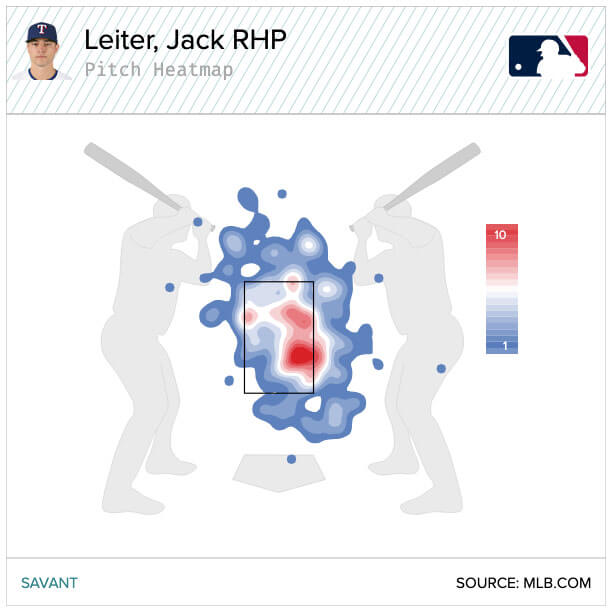
Six percent of his fastballs are in the “waste” zone, too far from the plate to be competitive, and that percentage is in the bottom fifth of the league, right near Luis L. Ortiz, Freddy Peralta and Dylan Cease.
His four-seam fastball command is bad and not likely to get better. Maybe it’s good news, then, that he threw the slider more often than ever in his last start, and also that he’s introduced a sinker he seems to command better. Both things could unlock the excellent stuff and start producing better results, and soon.
But he’s no sure thing. His strikeout-minus-walk rate is terrible, he’s fallen apart in starts that should’ve been gimmes and his ERA estimators are awful. With starts against the White Sox and Cardinals up next, though, there isn’t a better young, high-upside starter with a good schedule and iffy results so far, so Leiter stands atop the heap. Bad fastball command and all.
Taj Bradley, Rays
When young pitchers come up through the minors in the Tampa system, they throw to one target until they reach the upper levels of the minors. The thinking is that they should simplify things and get used to finding the middle of the zone — throw good stuff in the zone, and good results will follow. Is it possible this approach has not served Bradley well? He throws nearly one in five of his fastballs down the heart of the zone, which is in the worst third of the league, and the heat maps for all of his pitches look pretty middle-middle heavy on Savant:
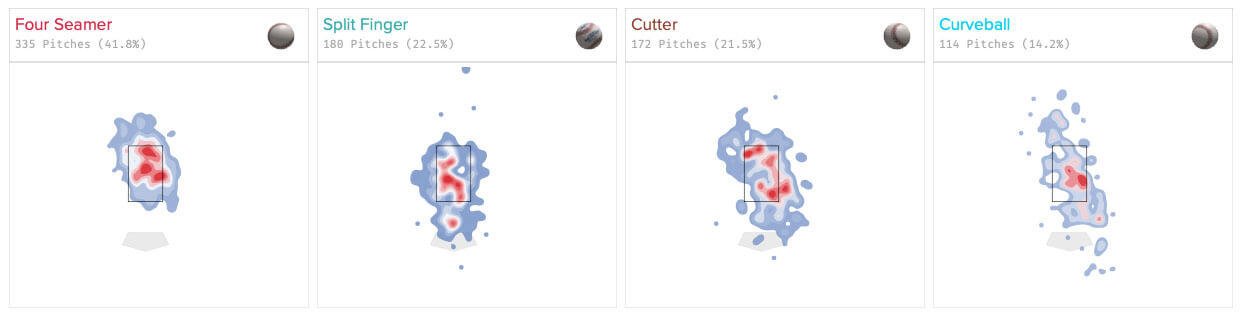
For his career, when the batter is ahead, Bradley throws the four-seamer 60 percent of the time. That’s an easy thing to circle for the hitter, and for lefties, which is still true this year. Bradley has upped the use of the cutter to righties this year in those situations, but he needs to push that number further against batters on both sides. He’s lost some vertical break on the fastball, and even the best fastballs can’t afford to be thrown middle-middle while the batter is ahead.
Advertisement
The bad news is that none of Bradley’s pitches are necessarily stuff standouts anymore, and those plus-plus strikeout rates of his debut probably aren’t coming back. The good news is that he now has four workable pitches, and if he were able to show the command to mix those four pitches in and out, he could still be a good pitcher. He hasn’t shown that ability yet. At least his next two matchups — Houston and Minnesota — are on the aggressive side of the league when it comes to chase rate. If he can’t do well in these two starts, the list of matchups where you want to turn to Bradley gets fairly small.
Shane Baz, Rays
It’s basically been four disasters in a row for Shane Baz, even if the one against the Blue Jays (three earned in less than five innings) had good strikeout numbers underneath the surface. The stuff numbers have actually started to fall as he desperately searches for a good way to set his inferior pitches around his excellent curveball. Does he have an arsenal, or just one good pitch?
Stuff+ says the slider should be around average, but it’s being pummeled, to the tune of a 1.353 slugging this year (and even last year’s .400 wasn’t great for a slider). The league is slugging .456 on sliders like his (using velocity and movement to group), and the closest sliders to his are the ones thrown by José Buttó and Quinn Priester. Though 86 mph is decent velocity for a slider, this kind of “gyro” slider — one with very little movement and bullet-like spin — benefits the most from velocity. The slugging percentage drops to .315 on similar pitches thrown between 88 and 90 mph, for example.
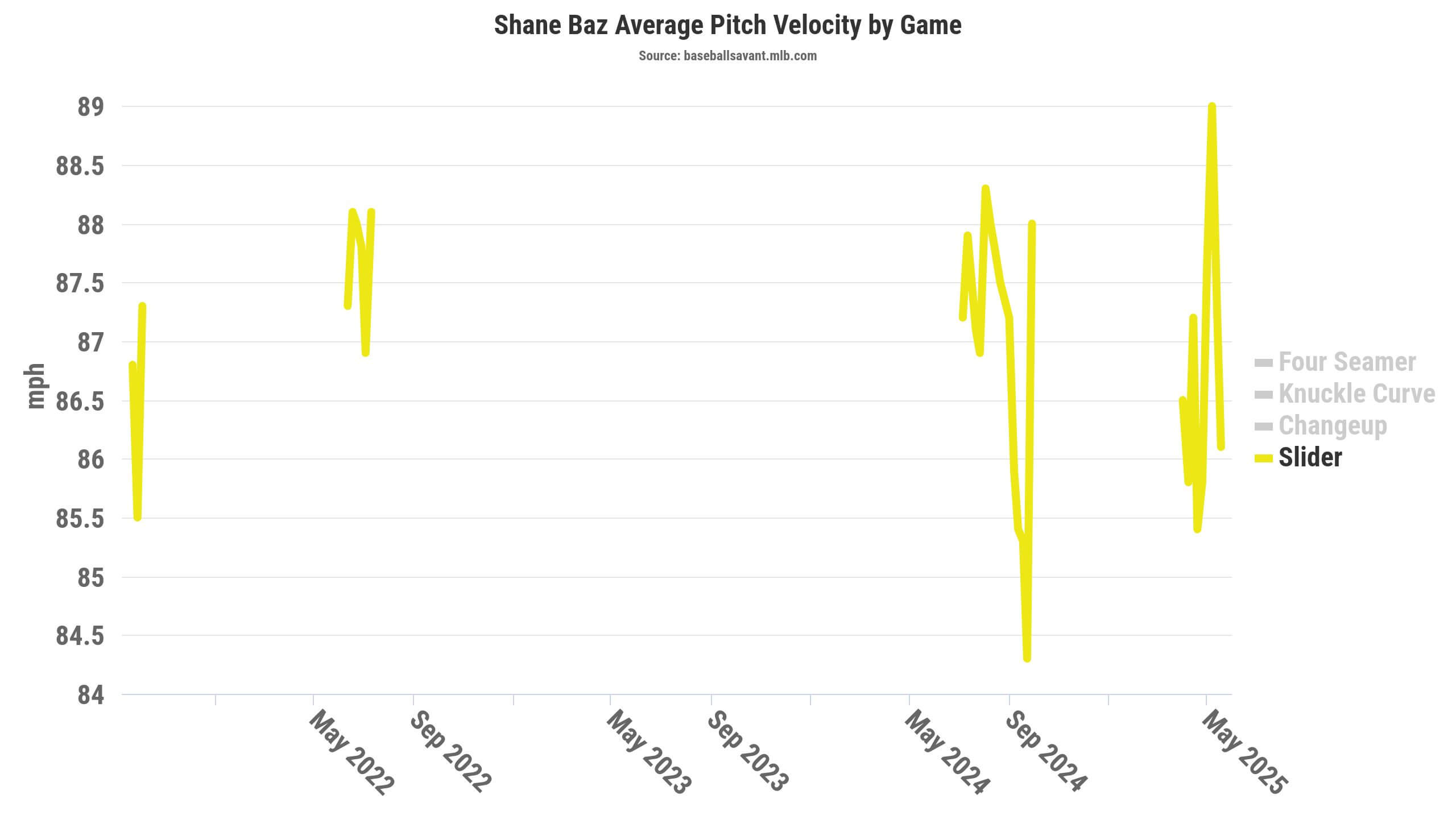
Without the slider, he becomes a two-pitch pitcher who pretty much just throws his four-seam up and his curveball down, and that’s something hitters can start to anticipate easily. He’s even been throwing the slider middle-middle a ton, so just getting it down would be good news.
Other fastball/curve guys who have had trouble with the slider have gone to cutters in the past (think Adam Wainwright), so that could be an avenue for Baz. And he’s thrown the slider 89 mph in one start, on average, so maybe the slider will improve. But neither seems as likely as it did just two weeks ago, and without a change in either his slider location and velocity, or his pitch mix, it’s hard to have any confidence throwing Baz against Toronto this weekend, especially since they’ve seen him this year already.
Michael Soroka, Nationals
This is Michael Soroka’s best pitch.
It’s a good pitch! You can already see from this that it’s not a dominant one. It only hums along at around 80 mph — because of the velocity and the shape, it won’t get as many swings and is a pitch better suited for called strikes and hit suppression. The expected swinging-strike rate on this pitch is 10 percent, which is not enough to float an entire arsenal.
Advertisement
His overall expected swinging-strike rate given his stuff is just over 11 percent, though, which would put him in the back end of the top third of the league: serviceable. The expected results on that pitch don’t vary too much against lefties or righties, though lefties are expected to swing much less against that pitch than righties, which puts pressure on his average-ish changeup. He’s got two fastballs and two secondaries, and he can mix them up with good command when he’s healthy, which he probably is now.
There’s no standout pitch here. Just a decent slurve and some OK fastballs. The ceiling is probably just an inch north of a league-average starting pitcher, but oh man, would that be a victory for the player, given what he’s gone through over his career. A start against the Giants this week seems like a good matchup for him, and we’ll know more about his mettle after the Diamondbacks start that comes after.
Carmen Mlodzinksi, Pirates
There have been some success stories around baseball that involve turning a sinker/sweeper reliever into a starter by adding just the right touch of pitch and arsenal design around it. I don’t think this is one of those that will last. Put succinctly, Carmen Mlodzinski does not have the pitches he needs to get lefties out.
The gyro slider is the only pitch that is above-average, stuff-wise, against lefties, and its success is theoretical right now, with a .609 slugging allowed (.473 xSLG). The sweeper, change, and four-seamer are all allowing slugging (and expected slugging) numbers over .450, and the Stuff+ model says deservedly so. Take a look at his Stuff+ numbers split up by hand, and put those in hand with the actual results, and the case seems to be made.
Mlodzinski, split into two
| Pitch | Hand | Thrown | Stuff+ |
|---|---|---|---|
|
Change |
vL |
53 |
99 |
|
Cutter |
vL |
4 |
89 |
|
Four-seamer |
vL |
139 |
82 |
|
Sinker |
vL |
7 |
79 |
|
Slider |
vL |
67 |
108 |
|
Sweeper |
vL |
60 |
99 |
|
Change |
vR |
4 |
99 |
|
Cutter |
vR |
7 |
97 |
|
Four-seamer |
vR |
113 |
98 |
|
Sinker |
vR |
77 |
117 |
|
Slider |
vR |
95 |
101 |
|
Sweeper |
vR |
59 |
122 |
As soon as Bubba Chandler gets on the same schedule as Mlodzinski in the minor leagues (instead of the same one as Paul Skenes), the countdown will be on. And Mlodzinski and Skenes pitch on back-to-back days.
(Photo of Jack Leiter: Richard Rodriguez / Getty Images)