



College Football Playoff administrators approved a proposal for a straight-seeding model for the 2025 postseason, confirms Brandon Marcello of CBS Sports. This represents a major change in Year 2 of the expanded playoff. Happy trails to automatic first-round byes for the four highest-rated conference champions and welcome to a less complex power-ranking of the selection committee’s top 12 teams.
New Seeding Criteria
Under the new seeding process, the top-four teams in the selection committee’s final rankings get a first-round pass to the quarterfinals. Last season, the four highest-ranked conference champions earned that distinction regardless of where those teams were slotted by the selection committee.
Why the Change Happened
Eliminating the conference champion auto-bye scenarios was a major sticking point this offseason after it resulted in an unbalanced bracket last December. No individual metric suggested Mountain West champion Boise State had “earned” the No. 3 seed last season as a more deserving team than 11-win Texas or Penn State with more competitive schedules, but the Broncos benefited from the highest-ranked conference champion rule.
Quarterfinals Undermined by Bye Rule
The top four seeds who received first-round byes last season — Oregon, Georgia, Boise State and Arizona State — all lost their opening games in the quarterfinals against opponents coming off wins the previous week.
Big Ten, SEC Pushed for Change
CBS Sports was one of the first to report the Big Ten and SEC openly supported a shift to straight seeding during a meeting between conference athletic directors and administrators in March after Penn State, Ohio State, Tennessee and Indiana were all kept out of the top-four discussion due to the conference champion rule.
Oregon’s Experience Highlights the Flaw
Unbeaten Big Ten champion Oregon was the top seed in last year’s playoff before getting the unlucky draw of eighth-seeded Ohio State in the Rose Bowl to open. The Ducks lost, 41-21, to the eventual national champions, but Dan Lanning refused to blame seed issues on the setback.
“We had an opportunity,” Lanning said. “We didn’t take advantage of the opportunity. I am not going to make excuses for our opportunity.”
Future Expansion Still on the Table
As previously reported by Marcello, discussions about expanding the field to 14 or 16 teams — with multiple automatic qualifiers reserved for the four power conferences — have been ongoing for months. The 12-team expanded playoff model’s contract ends after the 2025 season.
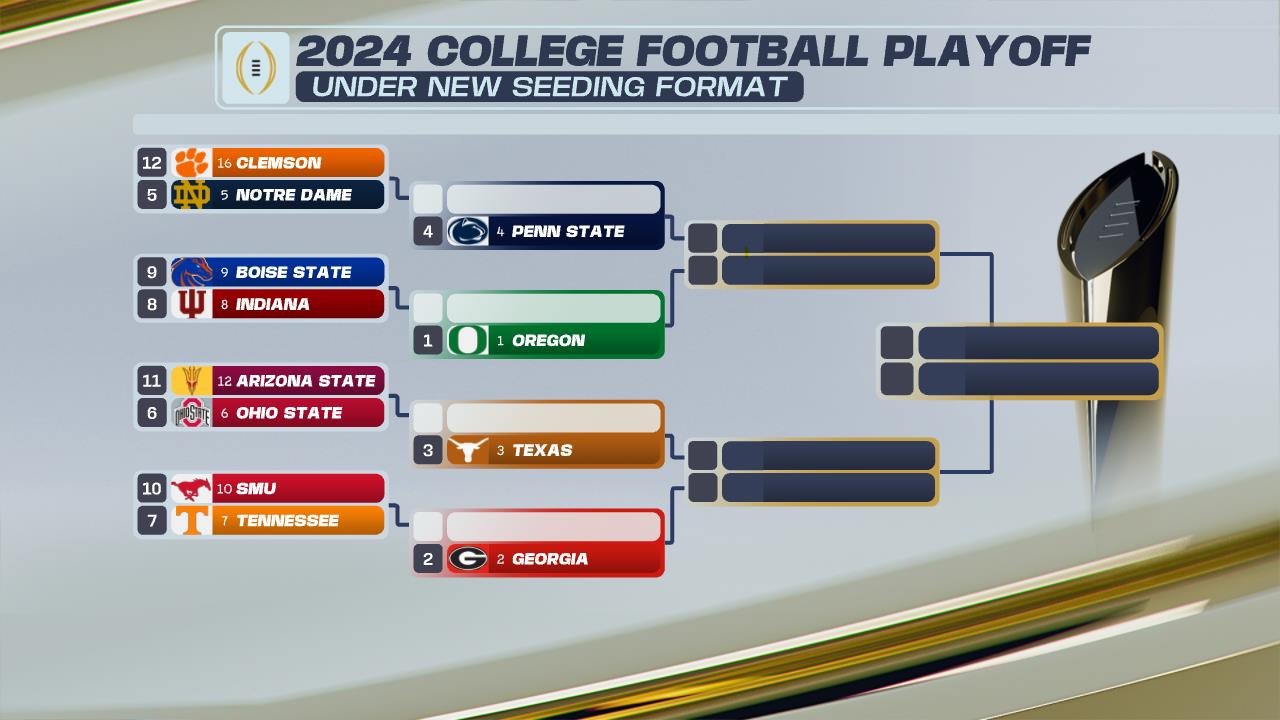
How the 2024 CFP would’ve looked with straight seeding
| 2024 seeding under new modelWhere teams landed in 2024 | |
| 1. Oregon Ducks (13-0) *Big Ten champion | No. 1 in final CFP Rankings, drew 1-seed |
| 2. Georgia Bulldogs (11-2) *SEC champion | No. 2 in CFP Rankings, drew 2-seed |
| 3. Texas Longhorns (11-2) | No. 3 in CFP Rankings, drew 5-seed |
| 4. Penn State Nittany Lions (11-2) | No. 4 in CFP Rankings, drew 6-seed |
| 5. Notre Dame Fighting Irish (11-1) | No. 5 in CFP Rankings, drew 7-seed |
| 6. Ohio State Buckeyes (10-2) | No. 6 in CFP Rankings, drew 8-seed |
| 7. Tennessee Vols (10-2) | No. 7 in CFP Rankings, drew 9-seed |
| 8. Indiana Hoosiers (11-1) | No. 8 in CFP Rankings, drew 10-seed |
| 9. Boise State Broncos (12-1) *Mountain West champion | No. 9 in CFP Rankings, drew 3-seed |
| 10. SMU Mustangs (11-2) | No. 10 in CFP Rankings, drew 11-seed |
| 11. Arizona State Sun Devils (11-2) *Big 12 champion | No. 12 in CFP Rankings, drew 4-seed |
| 12. Clemson Tigers (10-3) *ACC champion | No. 16 in CFP Rankings, drew 12-seed |