


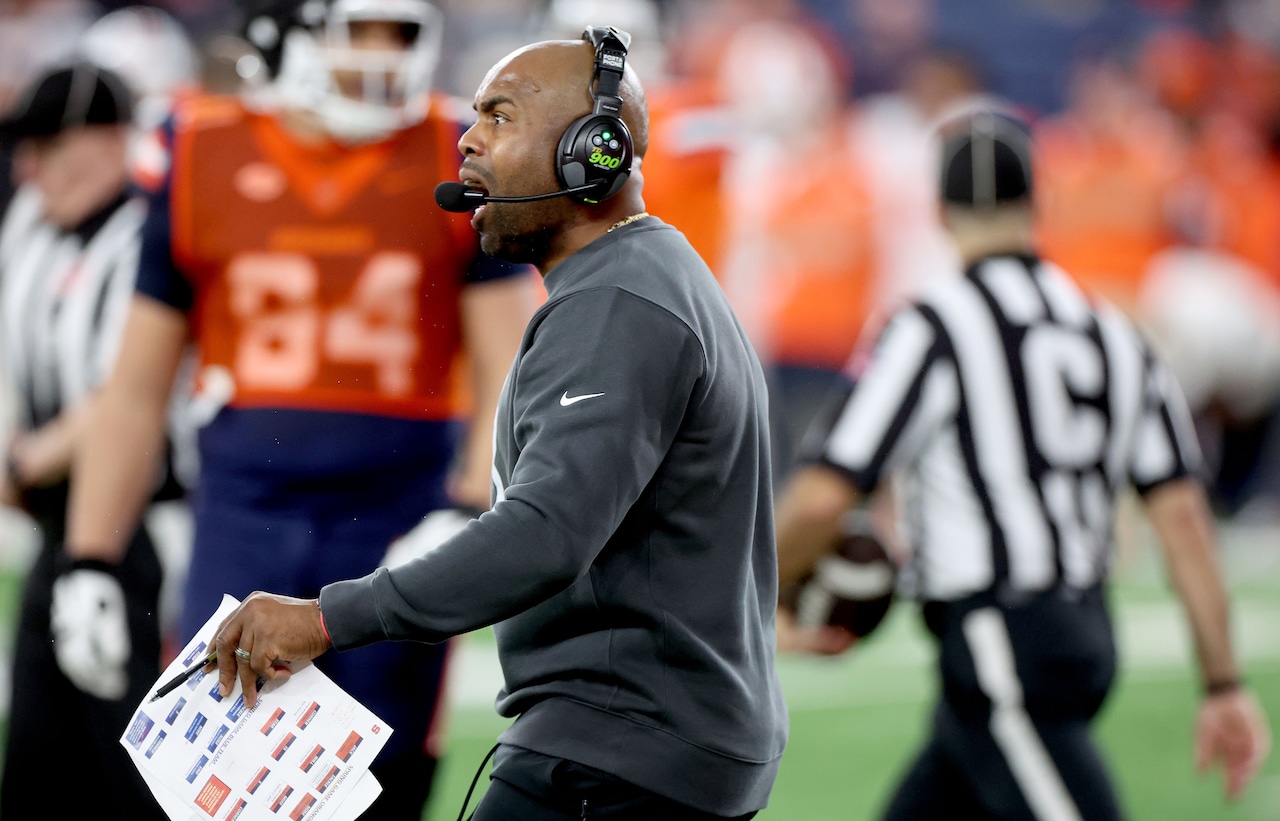
Syracuse, N.Y. — Fran Brown’s comments on Syracuse’s inability to reach a financial agreement with Trebor Peña were a message that’s been badly needed since paying athletes became permissible.
As Syracuse encourages its fans to donate to help pay its players, Brown showed he’s willing to make the hard choices with that money, to own his decisions and treat the game like what it actually is: professional sports played by athletes who are required to take college classes.
After years of school officials and coaches tiptoeing around reality, dodging conversations about the involvement of its coaches and acting embarrassed that it’s playing time and money, not education and love of alma mater, that matters to its athletes, Brown’s frankness was refreshing.
So was his willingness to accept responsibility for the choice to part ways with the most well-established player on the Syracuse roster.
In detailing those closed-door conversations with Peña during an interview on ESPN Radio Syracuse last week, Brown injected himself into the middle of the negotiation, ending the illusion coaches are simply conduits between players and boosters providing the cash.
Brown made it clear he is the coach and the general manager, the one in charge of deciding who gets paid and how much.
Peña was set to receive a raise after last season, Brown said.
The wide receiver believed he could negotiate a better deal this spring, according to Brown, and the school decided it wasn’t worth meeting his asking price.
“There were some numbers that were asked to me that I didn’t feel like I could do,” Brown said.
Honest. Real. Calculated.
A complete reversal from the way Syracuse has discussed its business since the onset of the athlete compensation era of college sports.
Brown discussed wide receivers across the country wanting $2 million, a valuation Brown intimated ought to be reserved for a future top NFL pick, such as Ohio State’s Jeremiah Smith or Colorado’s Travis Hunter.
It’s unclear if Peña told Syracuse he wanted that much. Or if he believes he’ll land a similar deal on the open market. Or if he asked Syracuse for a premium because his final season to showcase himself to the NFL would come against a daunting schedule with a first-time starting quarterback.
Regardless, Syracuse decided to rely on younger and less expensive options to replace Peña’s production.
That’s a calculated choice that professional sports franchises make routinely.
That’s the game that Syracuse is playing now.
Acknowledging that is a huge change for a school that has discussed paying players with the same level of transparency that most people display when discussing their eating habits with the doctor.
In the years since the NCAA has changed its rules around paying players, the performance of Syracuse’s athletic department has lagged. The school currently ranks 67th in the Directors’ Cup competition, which aims to crown the country’s top-performing athletic department.
Syracuse has been timid even talking about paying players. Former men’s basketball coach Jim Boeheim has said the school was slow in recognizing the importance of paying athletes.
That overly cautious approach has been obvious.
In 2022, at the outset of the new era, athletic director John Wildhack said the school was not going to “buy” players.
The next year, Boeheim accused opponents of “buying” players and booster Adam Weitsman stepped away from his luxury suite and courtside seats, saying he believed the school was uncomfortable with his willingness to discuss paying athletes.
Around the same time, former football coach Dino Babers deflected a question about whether Syracuse could compete financially in football and steered the conversation to academics.
With NCAA guidance changing routinely and virtually no enforcement, Babers often behaved as if knowing anything about how much players were being paid would implicate him in breaking rules.
When Syracuse finally launched its official collective that year, well after most of its peers, Wildhack offered a rationale for the slow progress.
“Sometimes it’s best not to be first,” Wildhack said. “You get to learn by observing a little bit.”
The school regularly stressed its collectives operated independently from the school, although they communicated with coaches.
Syracuse is not alone in clinging to a bygone era.
Officials and coaches across the country are still so uncomfortable talking about payments that they refer to the money athletes receive as NIL (name, image and likeness), a euphemism for the pay-for-play transactions shaping every team roster.
While players do have to do an NIL activity (like perform charity work or appear in an advertisement) to make their money, that’s only because the current rules demand it.
Most major-sport athletes are being paid to perform for their school, not because they make a good spokesperson or have followers on social media.
Brown, to his credit, did not bother to go along with the charade.
The coach’s comments showed someone who is heavily involved in every decision impacting his program. He determines each player’s value, not a collective, business or staff member holding a clipboard.
Brown is not a bystander. He is in charge.
It was a watershed moment in the timeline of how SU athletics reckons with the game it’s playing.
Just four years after talking like “buying players” was a moral failure rather than a commonsense competitive strategy, here was a Syracuse coach providing his side of a contract negotiation.
In the 22-minute interview, Brown shed more light on how his organization operates than the school had shown in four years, even acknowledging that other members of the team had reached out to him after Peña’s departure knowing that he now had more money to distribute.
“It ain’t a (lack of) money thing, just for everybody out there,” Brown said of not paying Peña his asking price. “Some of the players, when I told them, I said, ‘He’s leaving. He was getting paid a little bit.’ You know what they were doing that night? I got so many texts. … They aren’t calling upset that he left. … ‘Coach, let me get a couple dollars.’ ”
In the interview, Brown shared his belief that many wide receivers are replaceable, blasted Peña for questioning whether a rookie quarterback would hurt his future earning potential and said other departures from the program were imminent because he’d told players they’d been cut.
It’s the kind of talk heard every day on NFL Network.
It’s the kind of thinking that permeates in places like Columbus, Ann Arbor, Tuscaloosa and Athens, where Brown got a front-row view into the inner-workings of a college football citadel.
Brown will have to do business wisely. History tells us Syracuse won’t be the biggest spender.
The Orange won’t play the role of the Los Angeles Dodgers, spending lavishly on spoils of talent. If it was going to, it probably would have kept Peña and promising defensive tackle Maraad Watson.
But the Orange can aspire to be the Tampa Bay Rays, a well-run franchise with a low payroll that gets results by making tough decisions, maximizing their return on investment and trying to innovate.
Letting Peña walk was part of that.
Brown’s decision – and his willingness to explain it to fans – showed Syracuse’s football program is being run the way it should be.
The bucks start with the head coach. They stop with him, too.
Contact Chris Carlson anytime: Email ’ Twitter ’ 315-382-7932
>> Get more SU football insight and analysis delivered right to your inbox Monday morning. Sign up for our ‘Orange Football Extras’ newsletter for free