



Charlie Myers grew up in England, playing and loving European football. So he eagerly took a job last year at SkillsCorner, a Paris-based company that helps Premier League clubs use data to find players around the world. It was an untapped market for analytics, getting sophisticated tracking data, something beyond stats and film, on players in Argentina, Peru, Poland and elsewhere, then passing it on to the biggest clubs in Europe for their use in the ultra-competitive transfer market.
Advertisement
Before long, of course, the company realized there was another untapped market for a similar thing: American college football.
“The teams are all feeling the pain of the transfer portal,” said Myers, speaking with an English accent but a very American understanding of college football. “It’s interesting because college football doesn’t have centralized control, like an (NFL) salary cap. It’s very similar to European football.”
But what SkillsCorner hopes to provide college teams — big and small — it sees as a big differentiator for programs.
“It’s a very clear fit between problem and solution,” Myers said. “It’s an area that we expect is going to grow.”
That seems like a good bet. At the American Football Coaches Association convention in January, there were at least five companies with booths advertising their ability to research for the transfer portal. Some other companies were not as obvious but have been contracted by teams.
While it’s a relatively new and evolving industry, many programs already dabble in advanced recruiting analytics. Some use data from Pro Football Focus. SportSource Analytics, whose schedule strength data is used by the College Football Playoff committee, has a tool called Coaches By the Numbers. One general manager for a Group of 5 program told The Athletic he uses it along with PFF to get basic data, such as games started, snaps played and PFF grades.
“But I’m watching tape. At the end of the day, the football tape is going be what we determine our final evaluation,” the GM said. “But yes, I’m using (advanced data) to get my initial information.”
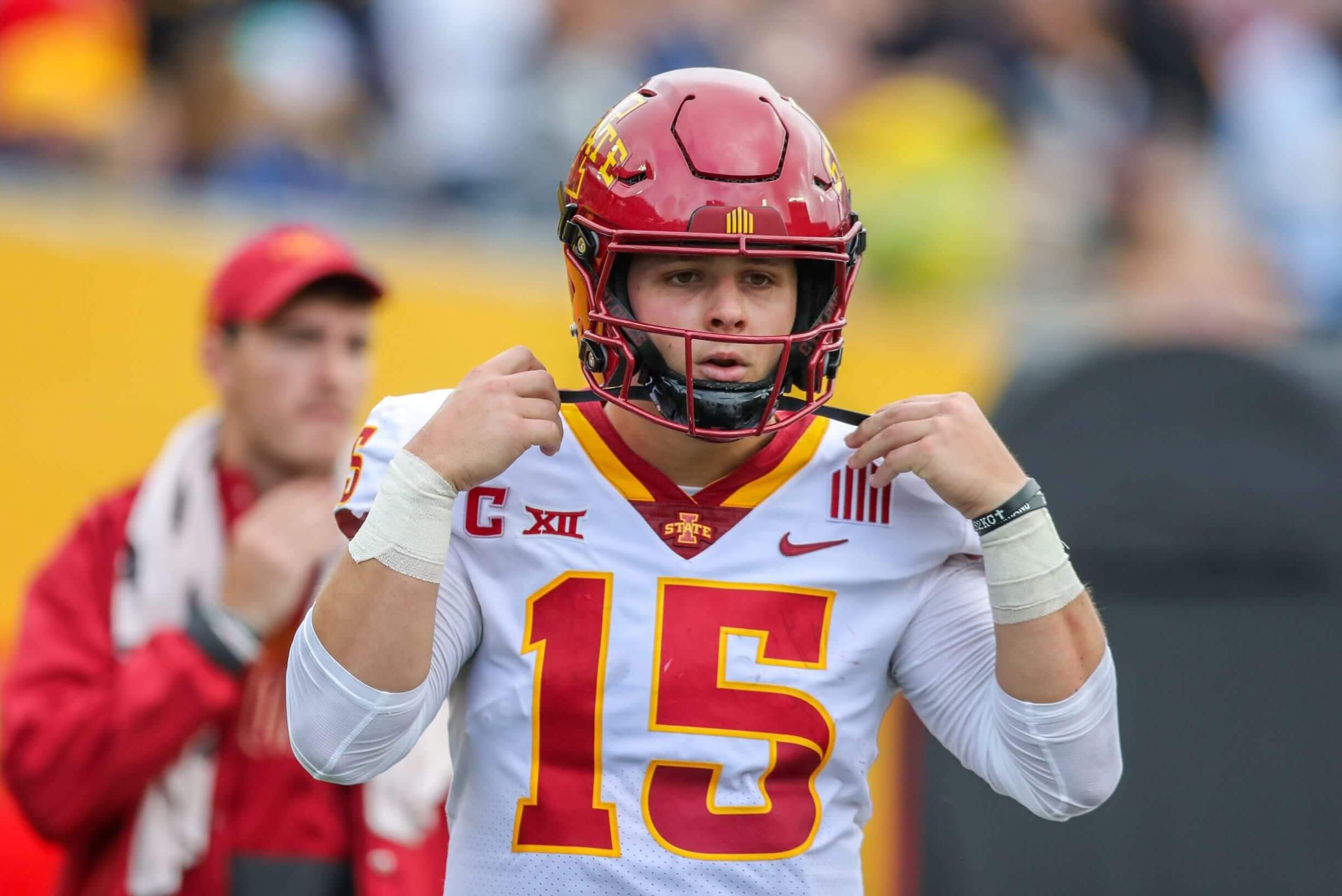
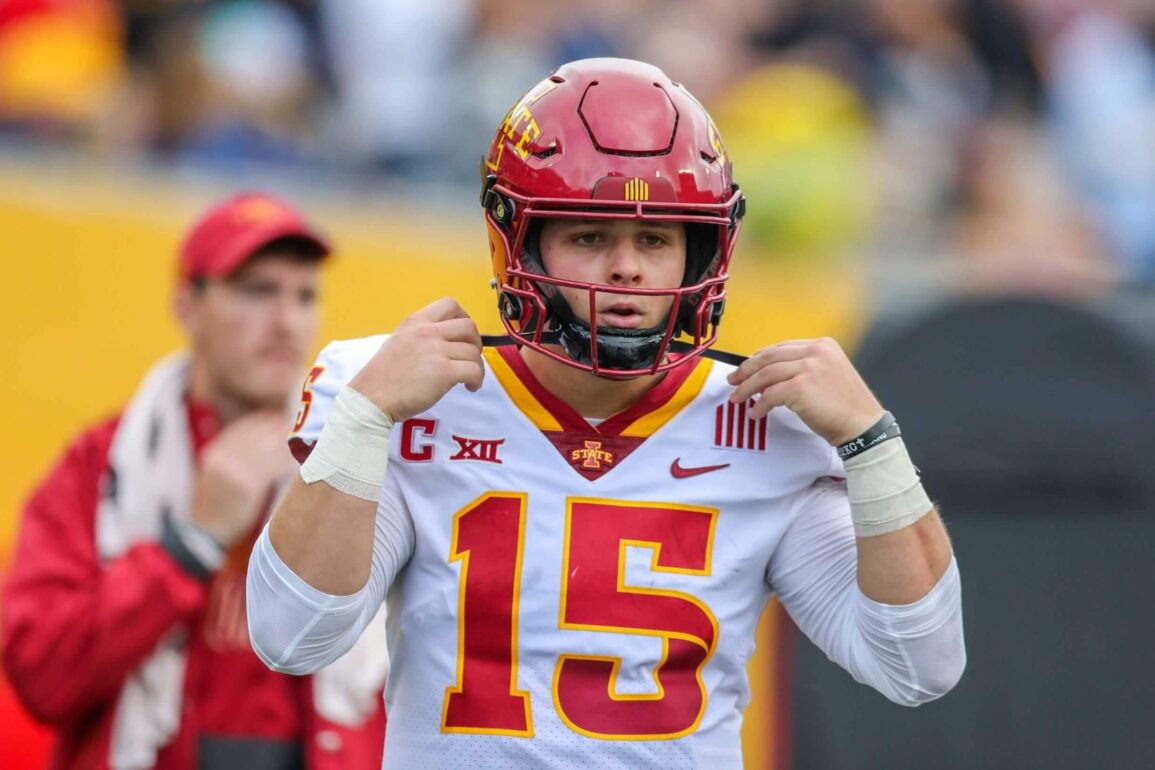
Former Iowa State quarterback Brock Purdy (15) was drafted by the San Francisco 49ers. (Ben Queen / USA Today Sports via Imagn Images)
Many analytic companies believe they can offer much more.
Hudl is well-known to most recruiting junkies and high school football fans, mostly just as the source for video of highly-recruited players. But the company is becoming much more involved in the transfer portal and is a source of more sophisticated data on players.
Advertisement
At many high school games, especially if they involve a top-500 player, Hudl will have an automated camera, a big white box that hangs on top of the press box, filming games. The public tends to only see the big, impressive plays that emerge from those games, but Hudl uploads all plays involving the key players, and almost every FBS program — and many at other levels — pay for the use of Hudl’s website to research players.
A player who didn’t play much, or at all, for his college team may enter the portal. Interested teams, therefore, would not have any college game film on the player — and his former team isn’t going to easily pass on practice film — but the high school film is still on Hudl.
“We can generally tell if a kid is in the portal or they’re going to be in the portal based on action on who’s watching the film,” said Matt Mueller, the Hudl COO.
Hudl is trying to go deeper than that: It acquired a company called Statsbomb last year, rebranded it as Hudl IQ and is using it to get more tracking data on players through that film. Then Hudl can use the data to group players by position, type of runner and by specific metrics: speed, acceleration and velocity and then by the first 10 yards of the run, then the next 15 yards and so on.
An example: A team wants a certain type of running back who is more of a physical, between-the-tackles runner. Hudl gives the team a list of all the players who fit that mold and then lists the metrics it came up with for every player.
“It’s more of a filtering tool,” Mueller said. “Our hope is to help the teams make the right bet faster.”
Some examples of what this advanced data looks like:
• For wide receivers and defensive backs, teams can get data for separation ability by tracking the distance between players throughout a play, doing it by milliseconds.
Advertisement
• For edge rushers, teams can get data for get-off time. Jared Verse was a first-round pick whose SkillsCorner’s data showed he was exceptionally well last year.
• For offensive and defensive linemen, the teams can track “knock-backs,” as in how much players are able to knock the person ahead of them.
This is the kind of analytics that has been happening for years in international soccer. Brighton in the Premier League is a well-known example: Club owner Tony Bloom used data to find talented players in less obvious places, but how and what data the team used is a closely-guarded secret. Much like college football, information is currency among soccer clubs, and paranoia is rampant.
SkillsCorner, more willing to talk in order to generate clients, started working about a decade ago with teams in the Premier League and then in the U.S. with Major League Soccer. That led to seeing how it could be applied in American football, first in the NFL. There was no need to install cameras; just get the all-22 film and then run it through the company’s computer vision algorithm.
Hayden Schuh played at Washington for Steve Sarkisian and Chris Peterson. He then coached at Cal and Montana State before transitioning into sports tech, first at an American company and then was hired by SkillsCorner when it moved into American football.
“We’re innovators. And we’re focused on helping teams innovate,” Schuh said. “Hopefully, we can help college teams scout like NFL teams.”
An example where the data was predictive: SkillsCorner’s data last year identified Holy Cross receiver Jalen Coker as an underrated player who could succeed at the next level. The company put data from many receivers in a graph, and the dot that stood out was Coker: He was below average in top speed but significantly above average in quickness. His 40 time was a 4.57, but his separation ability was significantly above average.
Advertisement
“He was a very fluid route runner; that showed in his data, his top end speed and accelerations,” Schuh said. “And even in specific route types, in being able to create separation, in moment of the snap, moment of the throw, moment of the catch, he was able to create separation.”
Coker went undrafted but was signed by the Carolina Panthers and had 478 receiving yards as a rookie.
Brock Purdy was another example from a few years back. The quarterback had high numbers that belied his lower prospect status, and San Francisco ended up with a steal taking Purdy with the final pick of the 2022 draft.
This is what SkillsCorner, and companies like it, are hoping to bring to college football, or already are.
“At its core, it’s about making smart decisions,” Myers said. “The big teams with the big budgets have the spending to pull players. Whereas teams lower on the pyramid, when you’ve got limited resources and these decisions can make or break your season, how can we help you make the right decision.
“This kind of sophisticated player recruitment is going to be a big differentiator for a lot of programs, particularly below the cream of the crop.”
— The Athletic’s Sam Khan contributed to this report.
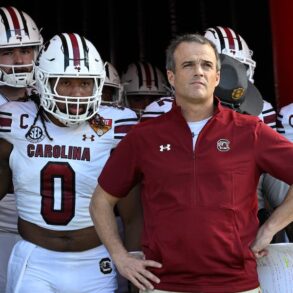
(Top photo of Jalen Coker: Alan Arsenault / USA Today Network via Imagn Images)