

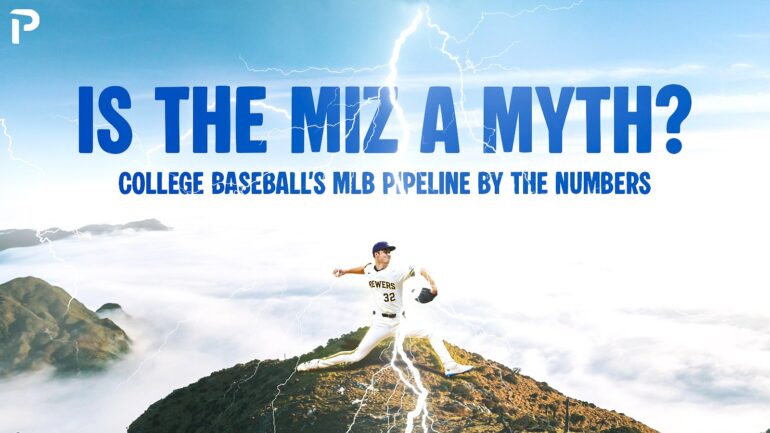
Jacob Misiorowski’s journey from a Missouri community college to the top of a major league rotation has become one of baseball’s favorite underdog stories. A new data study asks whether that path is a real blueprint for young players or a rare exception, and the answer it reaches matters for every prospect weighing a college choice, according to Pitcher List.
From Crowder College to MLB’s best
Misiorowski, known as “The Miz,” went 16-5 with a 1.80 ERA for the Milwaukee Brewers in 2026, leading the majors with 252 strikeouts in 174 2/3 innings. His fastball averaged 100.6 mph, Pitcher List reported.
He was not a blue-chip recruit. Perfect Game ranked him as the 13th-best prospect in Missouri in his high school class. He committed to Oklahoma State but did not receive a full scholarship, and his family could not cover the rest of the cost. He enrolled instead at Crowder College, a junior college in Neosho, Missouri.
After an injury wiped out his freshman season, Misiorowski went 10-0 with a 2.72 ERA as a sophomore. He then signed with LSU, but as a junior college player he was eligible for the draft, and the Brewers took him in the second round in July 2022 and signed him to an over-slot deal.
What the numbers show
To test whether his route is repeatable, the analysis surveyed the college affiliations in MLB’s records for every player who appeared in a major league or affiliated minor league game in 2026, roughly 1,500 MLB players and 7,900 minor leaguers. Schools were grouped by their 2026 conference membership.
Among players with an identified college, schools outside the Power Four conferences account for more than half of the affiliations at both the MLB and minor league levels. That partly reflects sheer numbers: the Division I roster data used in the study counted 9,236 non-Power Four players against 2,434 at Power Four programs, not including Division II, NAIA or junior college players.
Even so, the much smaller Power Four group makes up nearly half of the identified college affiliations in pro baseball. What the data cannot settle is how much of that comes from the talent big programs recruit and how much from the coaching they provide.
Money and the transfer portal
The study also points to the gap in resources. Oklahoma won the 2026 Men’s College World Series and reported nearly $7 million in baseball expenses, while Division II champion Tampa reported about $1.8 million and Tennessee about $11.4 million, according to Equity in Athletics Data Analysis figures cited by Pitcher List.
The transfer portal muddies the picture further. Tennessee had nine players selected in the 2025 draft, including left-hander Liam Doyle, who went fifth overall to the St. Louis Cardinals, and slugger Andrew Fischer, the No. 20 pick by the Brewers. But only two of those nine began their college careers in Knoxville, and four started at non-Power Four schools.
Playing time over prestige
The conclusion: The Miz is not a myth. His rise shows the value of good coaching and the chance to put it to use. A Power Four program’s track record of producing pros deserves weight, the analysis says, but so does the role a player can realistically expect to have there.
For a recruit picking a school, the study argues, the bigger question is not where he plays but whether he plays. A spot in a smaller program’s lineup may be worth more than a seat on the bench at a powerhouse.