

“What do you do in the offseason?” they ask. Oh, just write about a Power 4 head coach getting fired in March.
Note: Submitted questions have been lightly edited for length and clarity.
With Stanford coach Troy Taylor out, who do they go after so late in the cycle? — Jeff H.
The statement general manager Andrew Luck put out Tuesday (which I’m guessing was the first time a lot of people learned that Luck, not an athletics director, now runs Stanford football) said they’re conducting a coaching search while also leaving open the possibility of going with an interim coach this season. That’s probably dependent on whether Stanford can attract a quality pool of candidates this late. If not, they might want to hold off until November when more coaches might be interested.
Advertisement
But I’d note that Kansas found itself in this same predicament in March 2021 when Les Miles got fired over allegations of misconduct toward women while at LSU, and needless to say, they got a good one. And Lance Leipold, then at Buffalo, beat out another impressive finalist, Army’s Jeff Monken. Monken for one would make a lot of sense at Stanford, but Group of 5 guys in general would likely be less concerned about leaving their current teams in the spring. If you pass on this Power 4 job, who’s to say you’ll get another crack?
However, Stanford is not exactly an ideal P4 job these days. The stadium is largely empty on Saturdays. The ACC is an awkward fit for that program. The school is three years behind on NIL, and while it plans to fully fund revenue sharing, it’s unclear how it can afford it while receiving a 30 percent share of conference revenue.
But I do think Luck could be a big appeal. The new coach is going to work directly with a highly respected guy who’s all about football, rather than an AD who’s managing 36 sports. And from what I’m told, NIL donations have gone up significantly since he got involved.
If not Monken, there’s another former service academy coach not far south on the 101 right now: San Jose State’s Ken Niumatalolo, Navy’s former coach of 16 seasons, took the Spartans to a bowl in his first season while running a full-on passing offense under offensive coordinator Craig Stutzmann. I don’t think you could go wrong with either Niutmatalolo or Monken, whose team just won 12 games last season.
Which of these is most likely to be the case five years from now? — Jason K., East Lansing, Mich.
a) Deion Sanders is coaching the Dallas Cowboys.
b) Deion Sanders is coaching at Florida State.
c) Deion Sanders is coaching an FCS team.
d) Deion Sanders is coaching a mid-level bowl team at Colorado
I have a different order today than I would have a year ago. I do think Deion is committed to Colorado. If he wanted to be the coach of the Cowboys he probably could have landed the job a couple of months ago. Instead, after that brief flirtation, he said, “I know it’s cute, but I couldn’t coach pro ball,” lamenting the lack of intensity in NFL practices (not the first reason I would have guessed, but that’s what he said).
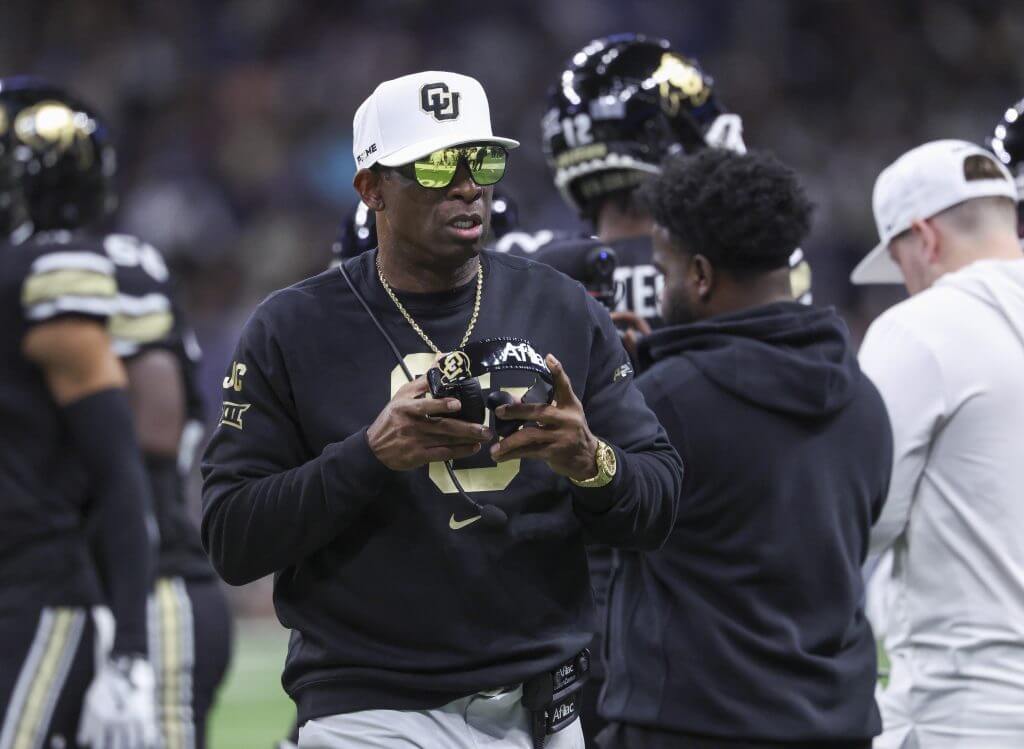
Where will Deion Sanders be in five years: Colorado, Florida State, the FCS or with the Dallas Cowboys? (Troy Taormina / Imagn Images)
What we can’t predict is whether his commitment to Colorado will remain as strong if he has a rough first season without Sheduer, Travis and Shilo. Notably, he’s yet to sign a new contract, one that athletic director Rick George first mentioned he was discussing with his coach in early December. Sanders is in the third year of his original five-year deal, which paid him $5.7 million in 2024. Good money for most of us, but in the world of college coaching that ranked 38th in the country, according to USA Today.
Advertisement
And while I’ve never heard Deion complain publicly about anything with Colorado, it’s no secret that school’s NIL resources are not great. And these days that’s the No. 1 requirement for keeping any coach happy long-term.
Of those options, I’m going with B (Florida State), followed by D (Colorado), followed by A (Cowboys). I’m not even considering the FCS option.
Florida State is his school, and Florida State could be one more bad year from having to replace Mike Norvell. While it’s not an SEC or Big Ten job, FSU is about to be much closer to those financially than is Colorado thanks in part to the ACC now distributing TV revenue based on schools’ TV ratings. That may be coming at the right time for FSU. It’s going to cost north of $50 million to buy out Norvell after this season if it comes to that.
All that being said, my actual No. 1 Deion scenario five years from now is something Jason didn’t list: Out of coaching, full-time TV talk show host.
The season is a few months away. What big games are you looking forward to going to and covering? Maybe Top 5 from Weeks 1-3? — Jeff H.
My top 5 might differ slightly from others:
1. LSU at Clemson (Week 1): It’s a crucial game for both head coaches. Brian Kelly is 0-3 in season-openers at LSU, all of them against high-profile foes, which has hurt his reputation. And Dabo Swinney got waxed by Georgia in last year’s opener. He needs to prove he can still compete with upper-echelon opponents outside the ACC.
2. Texas at Ohio State (Week 1): While more glamorous than LSU-Clemson, this one comes in slightly lower for me just because the consequences for the losing team might be negligible. But I’m obviously curious to see the Arch Manning and Julian Sayin eras begin.
3. Michigan at Oklahoma (Week 2): I wrote about this one in more depth last week, but this will be our first glimpse of the Brent Venables Makeover at Oklahoma, most notably former Wazzu quarterback John Mateer’s first big game. Perhaps Michigan freshman Bryce Underwood’s too.
Advertisement
4. Notre Dame at Miami (Week 1): Notre Dame’s first game post-CFP run is a Sunday night special against a semi-rival. And it will be our first time seeing former Georgia QB Carson Beck in a Hurricanes uniform.
5. Georgia at Tennessee (Week 3): This will be the first big SEC game of the season. There are going to be a whole lot of new faces on Georgia’s defense. And I’d like to see signs of improvement from Vols QB Nico Iamaleava.
Honorable mention: TCU at North Carolina (Week 1). We’re all going to tune in that Monday night to see Bill Belichick on the UNC sideline for the first time, but I’m not sure the game itself will be a classic.
Will a Colorado-Syracuse joint scrimmage happen, and will we see more of this in lieu of spring games? — Brian S.
The schools have filed a waiver to receive an exception to an NCAA bylaw that limits it to 12 regular-season contests – game or scrimmage – against outside competition. The FBS Oversight Committee is expected to discuss that waiver request at its regular April 10 meeting, which is cutting it awfully close given Colorado’s spring game is on April 19.
I have no idea if it will be granted, but this seems like one of these rules that was enacted a million years ago (1992 to be exact) and it’s unclear why it existed in the first place. A lot of rules back then were driven by a desire to reduce expenses for the members, but that ship has long since sailed. If Colorado wants to foot the bill to fly the Syracuse football team to Boulder, so be it.
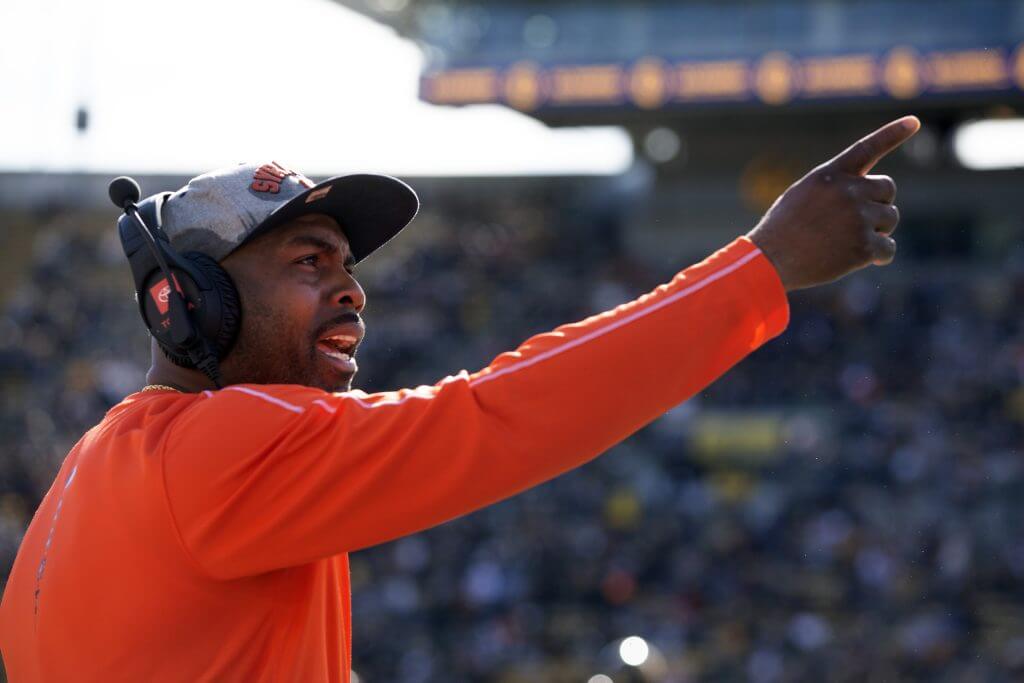
Syracuse coach Fran Brown, along with Colorado coach Deion Sanders, filed a waiver for joint spring practices (D. Ross Cameron / Imagn Images)
If it happens, and if it goes well, you’d have to think other coaches would consider following suit. Because now you have a legit opportunity to evaluate your roster against someone besides their own teammates. The injury risk is still there, the poaching threat (if it’s even real) is still there, but perhaps the benefits outweigh the risks at that point.
I hope it happens. If it does, I’ll definitely watch.
Advertisement
If the current trend continues where the SEC is a no-show in national championship games, will everyone else finally wake up and stop giving reverence to Greg Sankey and SEC? — Byron V.
Yes. But, sorry to be the bearer of bad news, it’s not going to continue.
The House settlement will force schools to publicly prioritize their sports. Is having an excellent women’s soccer team more important than signing an excellent defensive tackle prospect? It will be fascinating. Who will go all in on football and who will spread the wealth? — Melissa B.
As of now it appears all P4 schools that play football are going all in on football. Georgia announced in February it plans to allocate $14 million of the $20.5 million cap on football, and that’s become a commonly referenced number. Tellingly, Maryland, known more as a basketball school, announced that same $14 million football number, much to the chagrin of men’s basketball coach Kevin Willard, who’s been using his NCAA tournament press conferences to outwardly leverage interest from Villanova against Maryland.
It’s not surprising. Football accounts for 60 to 80 percent of revenue at most schools. And it drives realignment. Everyone wants to ensure they have a relevant football program if/when the next shoe drops – especially if it’s a Super League. But it definitely stands to puts pressure on schools such as Duke, North Carolina and Kentucky, where it’s no secret which sport the fans care about most. I’m particularly fascinated to see what Kentucky does, given it’s going to be incredibly expensive to fund a competitive SEC football roster.
As for other sports, certainly schools will need to reserve funds for women’s basketball, where the top players are now earning well into the six figures. But I’m not sure about the rest. As much as Vanderbilt cares about baseball and Oklahoma cares about softball, the reality is most of those players aren’t making big money. If you allocate, say, $2 million on baseball transfers, you may be inventing a market that doesn’t exist.
Finally, as I’ll say every week until proven otherwise, collectives aren’t going away. If you’re Duke, you may be able to spend two-thirds of your budget on football knowing the donors will gladly pitch in for a McDonald’s All-American. But no one will say that out loud because they somehow believe the fabled Deloitte clearinghouse is going to survive the instant legal challenges.
With all of the recent discussion around spring games, why do coaches like them? Building excitement around the fan base? Truly evaluate talent? Other? It would seem to me that with the amount of practice time these teams already have, the injury risk is not exactly worth it anymore. — Brennon M., Idaho Falls
Funny you should ask that. Given all the coaches racing to ditch spring games, I’d remind folks that there was no bigger proponent of them than the greatest coach in the history of the sport, Nick Saban. Alabama always held a “true” spring game, Team White vs. Team Crimson, almost always on ESPN, no funky scoring system, etc. And he made a big deal of getting as many fans there as possible. There were 58,710 at his last one in 2023. He considered it a valuable opportunity to evaluate less-proven guys in a game-like setting.
Mind you, most of his tenure predated NIL and the portal, so he didn’t have to deal with the current-day concerns of roster poaching. But even some current coaches think that’s an overblown concern. After all, tampering is an every-day thing in college football, not just in mid-April.
Advertisement
As I’ve said previously, spring games are for the fans. It’s a brief moment during the longest offseason in sports for the folks who spend their hard-earned money supporting their team to see the guys in uniform and get a sneak peek at next year’s team. Perhaps holding fan fests and glorified practices will have the same effect and it will turn out no one misses spring games at all. I myself am disappointed.
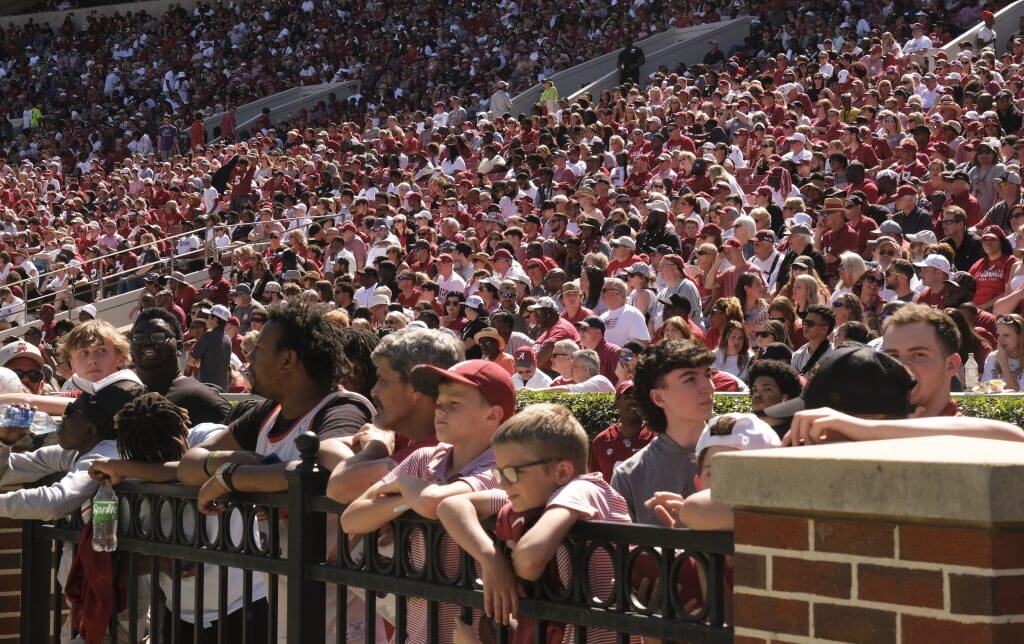
Alabama’s “A-Day” spring football game drew large crowds in the Nick Saban era (Gary Cosby / Imagn Images)
Hey, Stew: If you were making a football team using Disney movie characters, who would you pick and what position would they play? — Brian S., Buford, Ga.
I don’t have much to contribute here, but a lot of commenters did if you’d like to read their nominations.
Look into the crystal (foot)ball and predict any G5 wins vs. power conference teams this fall. If you had done this every year for the past 5-10 years, is the number trending up, down, or relatively stable? And what does that trend say about the health of the FBS level? — Bret C.
This is a particularly timely question, in light of this year’s no-Cinderella NCAA men’s basketball tournament.
Those upsets are definitely trending down in football, and I think we know why. The best G5 players are moving up to P4 because they can play right away and make considerably more NIL money. According to The Athletic’s Manny Navarro, there were 66 G5 players who both earned first-team all-conference honors last season and returned to college this year. Of those 66, 42 are now at P4 programs.
Remember that great 2021 Cincinnati team in the AAC that beat a top-5 Notre Dame team on the road and reached the Playoff? Its roster would have been finalized shortly before NIL went into effect that summer. I wonder how many of the Bearcats’ nine subsequent draft picks — including Sauce Gardner, Desmond Ridder and Coby Bryant — would have still been in Clifton by then were the transfer market what it is today.
We will still see G5-over-P4 wins, but these days it’s mostly top G5 teams knocking off mediocre P4 teams, like UNLV last season beating 4-8 Houston, 5-7 Kansas and 5-7 Oregon State, or Memphis winning at … 2-10 Florida State. It’s probably not possible today for Louisiana Tech to beat SEC champion Alabama (1999) or James Madison to beat ACC champion Virginia Tech (2010). And Appalachian State-Michigan (2007)? Someone would have scooped up Mountaineers star quarterback Armanti Edwards for $1.5 million to $2 million prior to that season.
All of which rings sad, but, these kids’ livelihoods are more important than my entertainment.
Advertisement
This is by no means an exhaustive list, but a few to consider this coming season: Toledo over Kentucky, UNLV over UCLA, Tulane over Northwestern and Memphis over Arkansas.
Will the Cincinnati Bearcats have a chance to win the Big 12? — E.B.
Absolutely. But so will 15 other teams.
(Top photo of Army coach Jeff Monken: Danny Wild / Imagn Images)