
MADISON, Wis. — Luke Fickell stood on the Camp Randall Stadium field after Wisconsin’s first spring football practice Thursday morning and spoke with a level of humility that was rooted in the disappointment of his first two seasons. By no means was he focused on the past. But he certainly wasn’t going to make any bold proclamations about the future.
Advertisement
New offensive scheme? Thirty-three new scholarship players this spring? Tweaks to the defense? As Fickell put it: “Time will tell.”
“I’ll try to keep my mouth shut because I think we’ve got to prove a lot of different things,” Fickell said.
His response was to a question about possessing more versatility up front defensively. But it may as well have been about everything related to his program. The message: Talk isn’t what matters. Producing on the field does.
That’s the backdrop to the start of Wisconsin’s third year of spring practices under Fickell. There is optimism about changes, many of which were on display on a sunny March opener. The caveat is that Fickell and his coaching staff must figure out how to translate that progress in six months when it matters most.
What are some of those critical changes that could make the difference? Here are seven takeaways from Wisconsin’s first spring practice:
Football is back!! 😁 pic.twitter.com/2bpJTmh26i
— Wisconsin Football (@BadgerFootball) March 13, 2025
1. Fickell said he altered his approach with players during January and February to create more time teaching football in the classroom and allowing them to see what coaches wanted in on-field walk-throughs. The result, according to Fickell, was that players were “further along” for spring practice. Whether that’s the reason or not, Wisconsin’s offense under new coordinator Jeff Grimes looked much crisper at the outset than it did under previous offensive coordinator Phil Longo.
That doesn’t mean there weren’t mistakes. Quarterbacks still missed receivers, and running back Dilin Jones put the ball on the ground twice. But there was a certain flow and variety to the offense that lent credence to Grimes’ comment this offseason about getting Wisconsin “back to what it’s known for.”
Advertisement
There were pre-snap motions, more involvement from multiple receivers touching the ball in the backfield, two-tight end sets, a balance of shotgun and under center snaps and even an occasional play that featured a fullback. It looked like the type of offense that blended some of what Wisconsin traditionally has done well with its physicality and combined it with an ability to throw from the shotgun and take advantage of openings on intermediate routes.
Maryland transfer quarterback Billy Edwards Jr. began spring as the clear-cut starter and made a handful of nice throws. He completed one for about a 20-yard gain to receiver Vinny Anthony along the left sideline and couple over the middle to receiver Trech Kekahuna for about 15 yards. The other outside wide receiver spot figures to be an entertaining competition that includes transfers Jayden Ballard and Mark Hamper. San Diego State transfer Danny O’Neil was the second quarterback, with freshman early enrollee Carter Smith and walk-on Milos Spasojevic earning reps with the threes.
2. Wisconsin’s first offensive line group featured left tackle Kevin Heywood, left guard Joe Brunner, center Jake Renfro, right guard JP Benzschawel and right tackle Riley Mahlman. Heywood, who will be a sophomore next season, is 6 feet 8 and 325 pounds and was the most likely replacement for Jack Nelson. Benzschawel played 58 offensive snaps last season, including 41 at right guard, and could fill the void left by Joe Huber. Brunner, Renfro and Mahlman are returning starters.
The second-team offensive line featured plenty of young talent and included freshman early enrollee Nolan Davenport at left tackle, redshirt freshman Colin Cubberly at left guard, redshirt freshman Ryan Cory at center, sixth-year senior Kerry Kodanko at right guard and redshirt freshman Emerson Mandell at right tackle. Leyton Nelson, a Vanderbilt transfer who missed last season, also earned work with the twos at left tackle. Barrett Nelson, who is Jack’s younger brother, is out with an injury.
Wisconsin’s third-team offensive line consisted of left tackle Michael Roeske, left guard Evan Brown, center Joey Okla, right guard Hardy Watts and Davenport at right tackle. Roeske and Watts are freshman early enrollees along with Davenport.
Advertisement
3. One player whose position switch this offseason could be tremendously impactful is Jackson Acker, who moved from running back to tight end. Tucker Ashcraft and Ball State transfer Tanner Koziol often were paired in two-tight end sets Thursday. But Acker earned reps with Koziol and worked with the second-team unit alongside tight end Grant Stec. Acker can catch passes from the tight end spot, out of the backfield or serve as a fullback — the position he originally played at Wisconsin.
“If there’s a guy that I think in the last two years that has grown in my mind an incredible amount, it’s him, and it’s not just as a football player,” Fickell said. “I just mean as a leader, a guy with the toughness side of things.
“He’s one of those guys I think that is in a position to have an incredible year. A lot of the things that we’re doing have a better chance for him to be put in a position where he can highlight the things that give him the greatest chance not only to help us but also to have a future in this game.”
4. Wisconsin began spring practice with just four scholarship running backs following Acker’s move to tight end. Sophomore Darrion Dupree earned the first reps, with Dilin Jones second and Cade Yacamelli third. Gideon Ituka is the other running back on scholarship. The Badgers were short enough on bodies that they moved walk-on safety Mason Lane to running back. Jones and Dupree have the potential to form an intriguing 1-2 combination and represent the biggest reasons why Wisconsin didn’t add a transfer portal running back this offseason.
5. One of Wisconsin’s most significant offseason objectives was to get bigger along the defensive line and at some of the linebacker positions. The Badgers clearly accomplished that feat in bringing in eight defensive linemen and linebackers from the transfer portal, as well as bulking up returning outside linebacker Darryl Peterson from 248 to 260 pounds so he can play with his hand in the ground. But the hope is that, beyond bigger bodies, Wisconsin has much greater flexibility with potential rotations.
The first spring practice was telling for the sheer volume of combinations that defensive coordinator Mike Tressel and his staff implemented. Ben Barten and UT-Martin transfer Charles Perkins worked inside up front with the top group, while Darryl Peterson and Western Michigan transfer Corey Walker played on the edge. Walker was listed last season at 270 pounds but is 297 pounds on Wisconsin’s spring roster. His ability to help set the edge could be critical for the Badgers, but he won’t be the only player counted on.
Wisconsin used Dillan Johnson and LSU transfer Jay’viar Suggs in one group inside with Walker on one edge and Sebastian Cheeks as a stand-up edge rusher. Other defensive line pairings insided included Perkins and Suggs as well as Barten and Tulane transfer Parker Peterson. Johnson and Brandon Lane were inside with Kentucky transfer Tyreese Fearbry and Grambling State transfer Michael Garner on the edge. Lane recovered a fumble when Jones couldn’t handle the handoff from O’Neil. Jamel Howard and Nolan Vils earned time inside on the defensive line with the third group.
Advertisement
Wisconsin also used a variety of combinations at the linebacker spots. Christian Alliegro and Tackett Curtis were, not surprisingly, consistently in the top group. But Aaron Witt earned time as the third linebacker in a role more off the ball from what he played last season. Other combinations included Witt, Thomas Heiberger and Western Carolina transfer Atarron Turner. Tyler Jansey earned snaps with Curtis. Jansey also paired with Heiberger and later Garrison Solliday.
6. Wisconsin’s top group in the secondary consisted of cornerbacks Ricardo Hallman and Nyzier Fourqurean with Owen Arnett in the slot. Preston Zachman and Austin Brown played safety. The second-team unit featured cornerbacks Omillio Agard and Jacksonville State transfer Geimere Latimer II with redshirt freshman Raphael Dunn in the slot. Bethel transfer Matt Jung and Richmond transfer Matthew Traynor were the backup safeties. Miami transfer D’Yoni Hill earned work at cornerback on the outside with Jay Harper for the reserves.
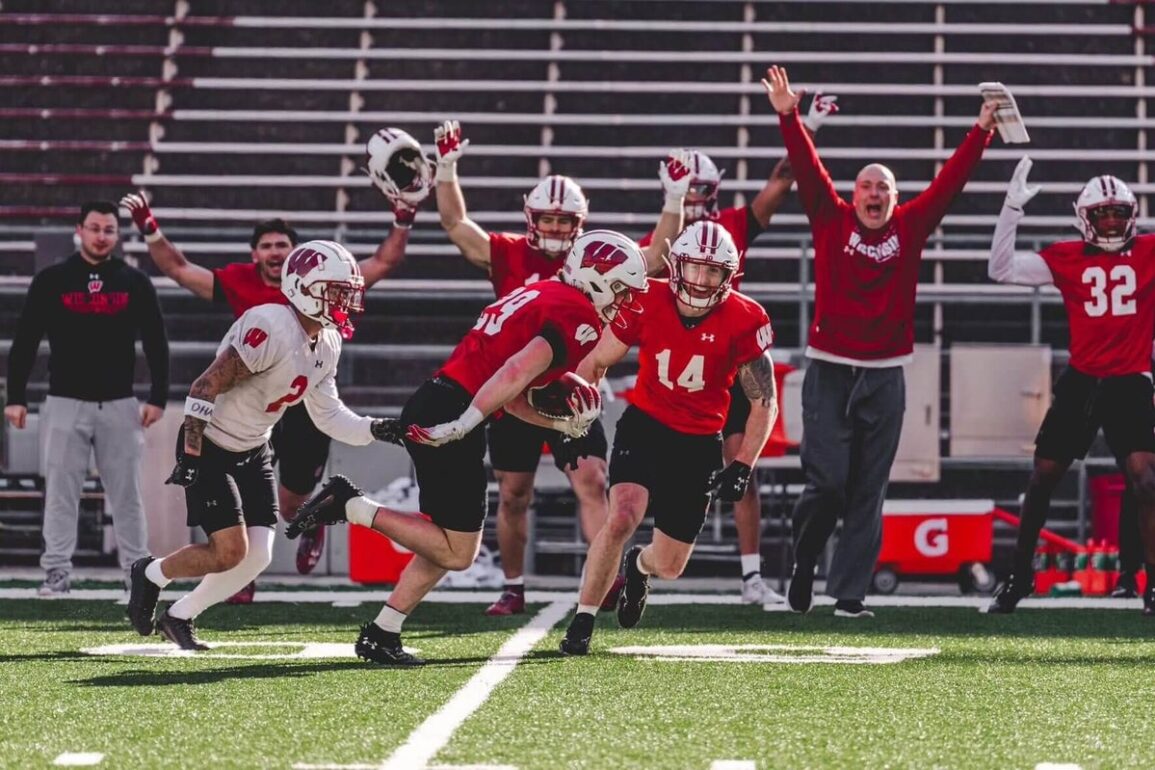
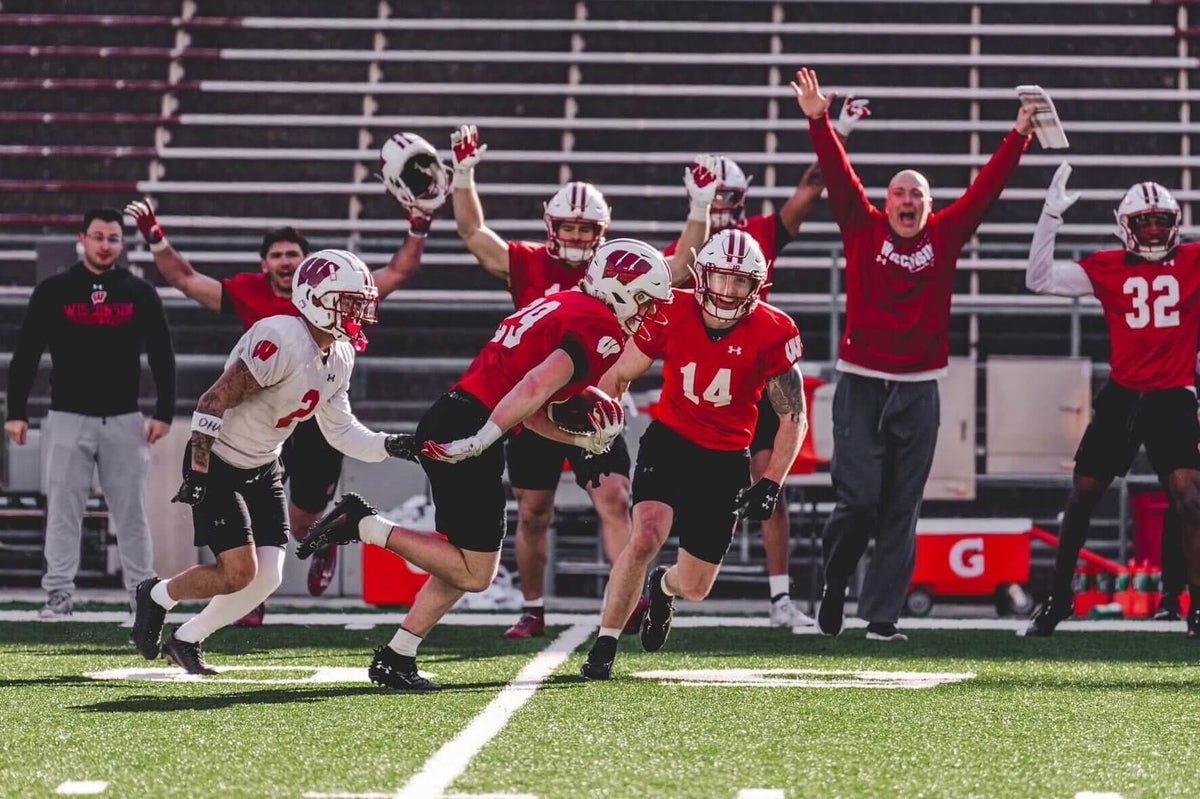
Jung simply has a knack for finding the ball. He led all of Division III last season with nine interceptions and four pick sixes. He intercepted O’Neil during a skeleton drill and nearly came up with another interception on a ball that bounced off the turf before he corralled it.
It remains to be seen what Wisconsin does with its nickel corner role. One option could be moving Brown to that position if one of the transfer safeties emerges as a potential starter alongside Zachman. Jung did earn snaps with Zachman when Brown worked in the slot.
7. Kicker Nathanial Vakos had an atypically uneven season for Wisconsin when he made just 12 of 19 field goals, which included 6 of 13 from 30-49 yards. Vakos’ search for more consistency got off to a good start, as he buried all three of his field goal attempts Thursday, including a 50-yarder. Gavin Lahm handled the backup attempts and went 1 of 3 with a 50-yarder that bounced no good off the right upright.
Wisconsin’s top two punters were Atticus Bertrams and Michigan transfer Stone Anderson. Bertrams is coming off an outstanding sophomore season in which he ranked fourth in the Big Ten with a punting average of 45.3 yards. The punt return group consisted of Ballard, Kekahuna, Dupree and Tyrell Henry, with Quincy Burroughs earning a try as well.
(Photo of Wisconsin safety Matt Jung making an interception Thursday in spring practice: Courtesy of Wisconsin Athletics)