




Yesterday we published a post explaining why trade talk surrounding the Portland Trail Blazers was somewhat muted this year despite the Blazers having at least four players available for trade offers and motivation to get a deal done. The basic summary:
- NBA salaries are increasingly polarized, with stars making in the $40-50 million range, role players around $15 million, and a bunch of other players on minimum salaries.
- Two of Portland’s prime trade candidates—Jerami Grant and Anfernee Simons—fall in between those tentpole spots, making $30 million and $26 million, respectively.
- This would all but require the Blazers to take back multiple players in return. But that’s not really practical at this point because…
- Portland doesn’t have open roster spots, and…
- In order to create same, they’d have to waive players already on their roster while still paying for same, which would put them over the luxury tax threshold, likely submarining the value of the trade from Portland’s perspective.
And there we sit, with almost no way around it. Except I was thinking… what if we reexamined one of the most sacred of cows in the NBA trade process?
As the Collective Bargaining Agreements between the league and its players have evolved, so too have the rules governing trades. This is the reason why ESPN’s Trade Machine exists. You can’t just trade any two players willy-nilly. Teams over the salary cap—and virtually all NBA franchises are—are required to match salaries within certain guidelines which become more restrictive the bigger the team’s salary ledger becomes. Figuring out whether a trade is legal requires figuring out whether salaries match within the guidelines.
The purpose for the restrictions is clear. The league wants to prevent imbalance among teams. Trade restrictions are an extension of the cap. They don’t want deep-pocketed or reckless-spending teams to absorb all the best players. Thus each team over the cap must send out salaries relatively equal to the amount they take in during a trade.
Except these rules aren’t exactly preventing super teams from forming, are they? The Phoenix Suns now have Kevin Durant, Devin Booker, and Bradley Beal. Their success so far has been limited, but by golly, they tried. And the Trail Blazers don’t have a hope of assembling a roster like that. The Brooklyn Nets and Golden State Warriors each took a swing before Phoenix, both with Durant. The Los Angeles Lakers had no problem getting LeBron James and Anthony Davis, two of the Top 75 players of all time. They even added future Hall-of-Famer Russell Westbrook to the mix for a while. The New York Knicks are currently trying their own version with Mikal Bridges, OG Anunoby, and Karl-Anthony Towns. Where there’s a will, there’s a way, restrictions or no.
That, in itself, is not an argument against trade rules, but these may be.
The idea of restrictions arose in a league that was, frankly, far less sophisticated than today. You’ll remember the “Ted Stepien Rule”, the one that prevents teams from leaving themselves void of first-round draft picks in consecutive years. That restriction got its name from the owner of the Cleveland Cavaliers who, back in the 1980’s, flushed away his team’s future first-rounders en masse in an attempt to win right away, failing spectacularly and leaving his larder bare in the process. Given the known value of the draft under current cap rules, any General Manager who tried that in 2025 would be shown the door before the second trade was completed. That also applies to most every GM who loaded up their team’s cap ledger with massive overpays without producing results.
That’s true, in large part, because the current CBA has made restrictions so draconian that exceeding tax aprons becomes its own punishment. Limits on sign-and-trade deals, loss of cap exceptions, loss or demotion of draft picks…teams exceeding the first apron feel the squeeze while teams exceeding the second are all but chained.
Is it possible that these rules—which did not exist before the current CBA—are enough to give teams pause when acquiring salary? If so, should the league allow franchises to incur those penalties should they deem it desirable, allowing other franchises to benefit by off-loading salary at the same time?
I’m toying with this idea. Keep the current penalties for exceeding the tax. Underline that teams over the second apron cannot make any trade that will increase their cap obligation for any reason. Once you’re over that second apron, you’re done. But up until then—until they make that last trade that takes them over the second apron—teams can trade players without regard for salary disparity should they so choose and pay the cost accordingly.
If the Blazers want to trade Jerami Grant for a young player and some draft picks and they offload $15 million in salary by doing so, how does that hurt them? If the receiving team wants to commit to the apron for Grant because they feel he pushes them over the top, but they reach the point at which they can’t add more players after that without losing some, how does that hurt them? And how does either hurt the league, really?
I believe most front offices are savvy enough nowadays to balance the value of cap space, draft picks, and current talent. If one franchise ends up mismanaging their assets, it’ll show. Why make the whole league jump through restrictive hoops for the sake of one or two of the stupidest groups, especially when they’re going to find a way to show their incompetence anyway, no matter what the rules? Preventing the worst outcomes doesn’t help much if it also clogs up the system so much that the best outcomes are harder to achieve.
Right now we have trade salary restrictions AND severe penalties for financial overcommitment. Would the world fall apart if we changed that to “or” and just let the penalties speak for themselves? If the Phoenix Suns want to Phoenix Sun, why wouldn’t a team like the Blazers feed them, watch them bog down, then walk away with the draft picks and/or cap savings?
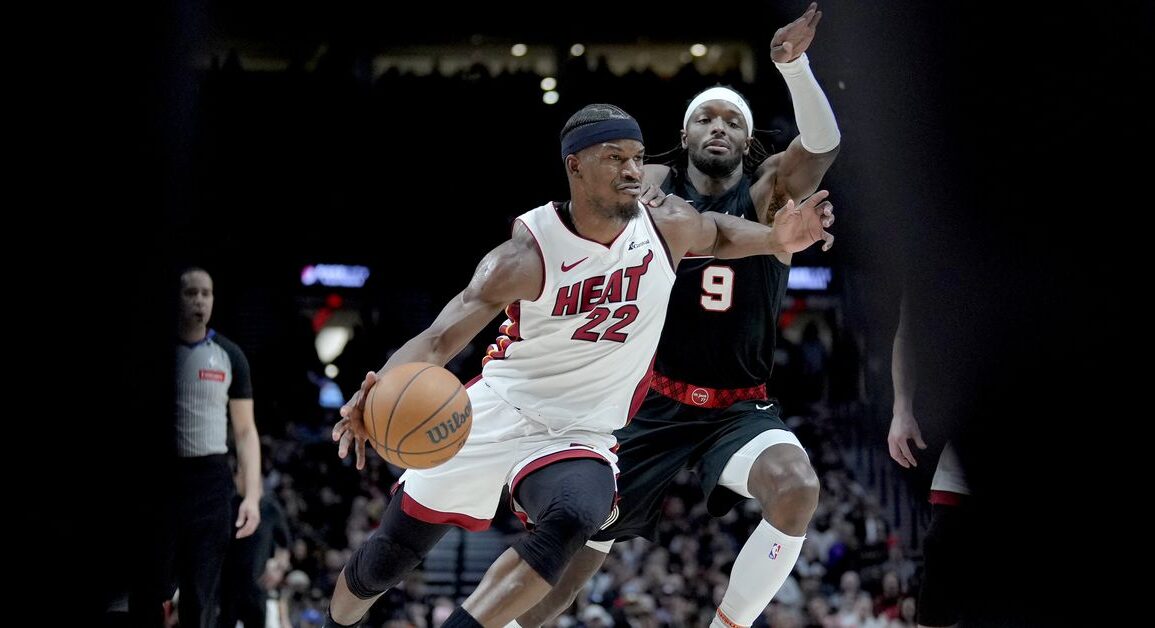
Why shouldn’t the Miami Heat be able to dump Jimmy Butler on the Dallas Mavericks, watch Dallas sign him to a $120 million contract, and let the chips fall where they may? If Butler were Shai Gilgeous-Alexander, we wouldn’t be having this discussion. He’s not. He’s a huge variable. His value is zero to the Heat right now. He could be something to the Mavericks. He’d get paid as they find out and Dallas would be on the hook for those choices as he aged. I fail to see the problem here. Who loses out in this equation?
This is just musing at this point, but what do you think? What would happen if the Blazers could trade Grant or Deandre Ayton for players making $10 million, free up their cap ledger sooner, and let someone else absorb both the talent and the cost that Portland doesn’t need right now? What hidden consequences or effects am I not seeing? Share your thoughts in the comments section below as we talk about the costs and benefits of having to match salaries in trade.