

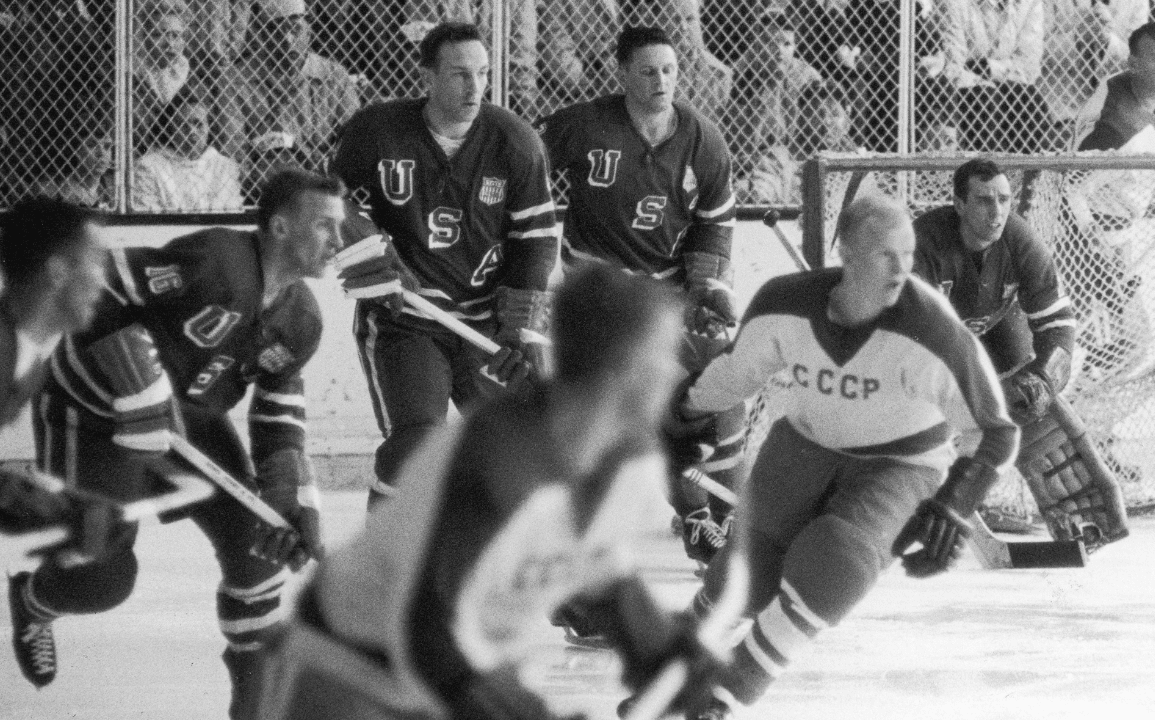
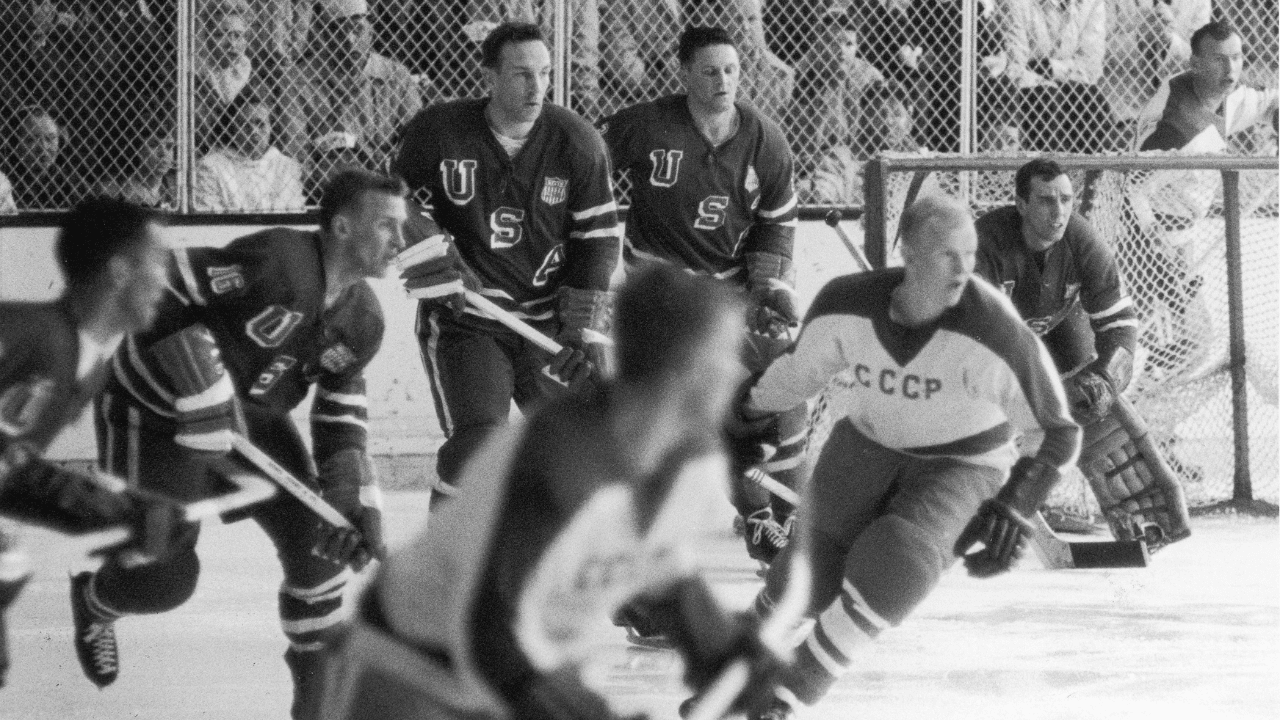
There were no gold medal games in Winter Olympic competition back then. Instead, the final round was a six-team round-robin tournament to determine the winner. The very next morning, after upsetting the Soviets the prior afternoon, Christian and his team faced Czechoslovakia, knowing it still needed to win to avoid being overtaken for gold.
After two periods, Christian and his group trailed 4-3, much the same way Team USA in 1980 trailed Finland 2-1 in a decisive must-win affair.
In the second intermission, the Americans got a surprise dressing room visit from Soviet team captain Nikolai Sologubov – who they’d beaten the day before. Sologubov and the Soviets knew they’d secure a medal and bump the Czechs from the podium if the Americans won.
“He didn’t want the Czechs to finish ahead of his team,” Christian said.
And to help make sure of that, Sologubov had brought an oxygen mask and tank into the dressing room with him and was offering it to the team USA players.
“Not a chance that would ever happen today,” Christian said. “Can you imagine a Russian player coming into a foreign locker room?”
Eight of the American players took him up on the oxygen. The U.S. then scored six goals in the final period to win 9-4 and claim gold with a perfect tournament record.
“My brother, Roger, he didn’t take any oxygen and he scored three of the six goals,” Christian said.
Bill Clearly wound up leading Team USA in total points with 12 for the tournament, while his brother, Bob, whose skills had initially been doubted, was third highest with eight. The Christian brothers each were tied for second-most points with nine apiece.
“They honored us for winning, but not around the country or anything like that,” Christian said. “It was just a different time. We all had to go back home to work. We didn’t get any (NHL) offers, so I went out to Seattle and my wife joined me out there for a while. And then I went back to Warroad and that was it.”
Almost 20 years to the day of his capturing gold, Bill Christian would be in the stands in Lake Placid to see his son, Dave, the Team USA leader in assists, replicate his feat with the 1980 team. They trailed Finland 2-1 after two periods, but, like their 1960 predecessors, scored three in the final frame to win 4-2 and take home the country’s second-ever gold medal.
Christian’s wife, Carol, now deceased, and daughter, Jeri – who will also be attending Saturday’s Kraken game to watch her son, Islanders winger Nelson — would hold up a “U-S-A!” sign and help start the chants that became popularized to this day by that 1980 team. Dave Christian went on to score 340 goals over a 1,009-game career with five NHL teams, one of 13 members of the 1980 team that eventually played in the league.
Meanwhile, only two members of the 1960 squad went on to play in the six-team NHL, that being goalie McCartan and forward Tommy Williams – who’d drawn the assist on Christian’s winner against the Soviets and in 1963 became the first U.S.-born player to score 20 goals in an NHL season.
As for Christian himself, he’s satisfied with being a key part of U.S. hockey history. Even if many of the fans sitting with him at Climate Pledge on Saturday have no idea about the feat or its upcoming 65th anniversary.
“Very few people in this country even knew about Olympic hockey back then – that there was such a thing,” he said. “So, it helped. It certainly helped to win the gold. We never got the media coverage like the 1980 team did. But we left a mark. And hockey in this country is better for it.”
*The name Squaw Valley is included with the intention to accurately represent history. However, the term is offensive, and the site name has since been changed to Yokuts Valley. Learn more about that here and the damaging impacts of mascot imagery and naming in sports here.